





1st Edition
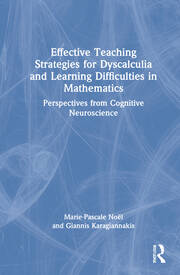
Effective Teaching Strategies for Dyscalculia and Learning Difficulties in Mathematics Perspectives from Cognitive Neuroscience
Biography
Marie-Pascale Noël is professor of psychology at the UCLouvain University in Belgium and senior researcher at the National Research Fund of Belgium. She has been interested in numerical development and math learning difficulties for many years. She teaches this matter in Belgium and abroad. She is also the head of a clinical centre in child neuropsychology.
Giannis Karagiannakis is a mathematician and a fellow researcher at the University of Athens. For many years he has been interested in numerical cognition, publishing related work. He leads training courses for educators worldwide for differentiation for learning maths. He is Chief Scientific Officer of the MathPro Education.
"In this engaging book, Noel and Karagiannakis provide a state-of-the art, evidence-based overview of methods and tools to help children with mathematical learning difficulties, such as Developmental Dyscalculia. This book represents an invaluable resources for educators working with students who present with mathematical learning difficulties"
Daniel Ansari, Full Professor at the Department of Psychology & Faculty of Education, University of Western Ontario
“Crammed with research evidence, diagrammatic illustrations and worked examples, this book is a one-stop-shop for everything an education professional might need to know about working with those with difficulties in learning mathematics. This book will be useful to mathematics teachers keen to understand dyscalculia, to educational psychologists and SENDCOs wanting to learn more about intervention strategies and mathematics, and to researchers and academics wanting a thorough grounding in these topics.”
Kay Kempers, FHEA, Lecturer in Special Educational Needs, Disability and Inclusion at Carnegie School of Education, Leeds Beckett University
