





1st Edition
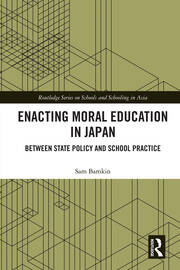
Enacting Moral Education in Japan Between State Policy and School Practice
Introduction 1. History, Politics and the Changing Policymaking Processes 2. The Disjoint Between Research on Policy and Research on Practice 3. Policy Evolution Through the Ministry 4. Making Textbooks for a 'New' Subject 5. Constructing a Baseline on Classroom Practice 6. Making Sense of Curriculum Content in the School 7. Enacting Pedagogy in the School 8. Translating Policy in(to) the School 9. Policy Enactment in Japan Appendix A. Fieldwork context and access Appendix B. List of participants (2018-2020) Appendix C. Textbook materials referenced
Biography
Sam Bamkin is Assistant Professor at the University of Tokyo, Japan.
"With a lengthy history of controversy within Japanese education, moral education was elevated to the status of a 'special subject' in March 2015. The author delves into not just the policymaking behind this change, but also its enactment at the local and school levels. The investigation reveals a multitude of noteworthy discoveries, foremost among them being the pivotal roles played by 'expert practitioners' owing to their well-versed understanding of the domain. Undoubtedly, this book stands as a commendable contribution to research on education policy and the study of moral education in the Japanese context."
- Masaaki Katsuno, Dean of the Graduate School of Education, The University of Tokyo, Japan."Sam Bamkin’s historically-informed ethnography gives the lie to some of the recent rather over-excited commentary about the introduction of a new – often described as ‘nationalistic’ - moral education curriculum in Japan. By skilfully delineating the multiple levels involved in implementing the new curriculum – from the Prime Minister to the classroom teacher – and demonstrating the multiple positions taken by actors within each level, he has begun to develop a new ‘theory of enactment’ which provides a very useful model for other areas of policymaking not just in Japan but elsewhere."
- Roger Goodman, Nissan Professor of Japanese Studies, University of Oxford.
"Moral education in Japan attracts feverish attention across the political spectrum. Sam Bamkin's outstandingly researched book sheds much-needed light on its realities, from policy to classroom practice."
- Peter Cave, Senior Lecturer in Japanese Studies, University of Manchester.
"This book aims to reframe the educational reform concerning moral education in Japan. Instead of viewing it as a one-way execution of policies from the central government to schools, it portrays it as an interactive process involving various actors, including school teachers, the board of education, and moral education experts. Through Bamkin's meticulous examination of this interactive process, we can rediscover that school teachers are not mere executors of policies from the central government but creative agents who generate diverse educational practices based on new values in their interactions with children and colleagues."
- Hiromichi Kato is an Associate Professor at the Graduate School of Education, Hokkaido University, Japan.
