




1st Edition
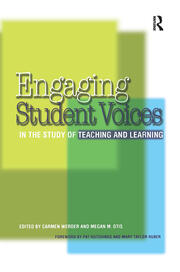
Engaging Student Voices in the Study of Teaching and Learning
Acknowledgements Foreword—Pat Hutchings and Mary Taylor Huber, The Carnegie Foundation for the Advancement of Teaching Section I. Foundations 1. Foundations of Student-Faculty Partnerships in SoTL. Theoretical and Developmental Considerations—Christopher Manor, Stephen Bloch-Schulman, Kelly Flannery, and Peter Felten 2. Students in Parlor Talk on Teaching and Learning. Conversational Scholarship—Carmen Werder, Luke Ware, Cora Thomas, and Erik Skogsberg 3. Participatory Action Research as a Rationale for Student Voices in the Scholarship of Teaching and Learning—Megan M. Otis and Joyce D. Hammond 4. Challenges and Caveats—Betsy Newell Decyk, Michael Murphy, Deborah G. Currier, and Deborah T. Long 5. Invoking the “L” in the Scholarship of Learning and Teaching—Jane Verner and William Harrison Lay Section II. Enactment 6. A Range of Student Voices in the Scholarship of Teaching and Learning—Kathleen McKinney, Patricia Jarvis, Gary Creasey, and Derek Herrmann 7. Equalizing Voices. Student-Faculty Partnership in Course Design—Ayesha Delpish, Alexa Darby, Ashley Holmes, Mary Knight-McKenna, Richard Mihans, Catherine King, and Peter Felten 8. Been There, Done That, Still Doing It. Involving Students in Redesigning a Service-Learning Course—Jessie L. Moore, Lindsey Altvater, Jillian Mattera, and Emily Regan 9. Engaging Students as Scholars of Teaching and Learning. The Role of Ownership—Ellen E. Gutman, Erin M. Sergison, Chelsea J. Martin, and Jeffrey L. Bernstein 10. Student Voices through Researching and Promoting Learner Autonomy—Michael D. Sublett, Jeffrey A. Walsh, Kathleen McKinney, and Denise Faigao 11. Capturing Students’ Learning—Tom Drummond and Kalyn Shea Owens Not the Conclusion. Sustaining Student Voices—Carmen Werder and Megan M. Otis
Biography
Carmen Werder directs the Teaching-Learning Academy at Western Washington University, where she also teaches rhetoric and directs Writing Instruction Support. As a Carnegie Scholar, she initiated an ongoing study of the use of personal metaphors in developing a sense of agency. She has headed up both CASTL initiatives on working with students as co-inquirers in the scholarship of teaching and learning: the Sustaining Student Voices cluster (2003-06) and the current Institutional Leadership Program Student Voices themed group (2006-09). Megan M. Otis is a graduate student in anthropology at Western Washington University. She has been an active participant in WWU’s SoTL initiative, the Teaching-Learning Academy (as both an undergraduate and graduate student), and has been deeply involved in the CASTL Student Voices group. Pat Hutchings
“Engaging Student Voices in the Study of Teaching and Learning illustrates the pedagogical power of extending the teaching and learning relationship to form an engaged and interactive partnership inside and outside the classroom. Not only does this book ground the practices of engaging students in developing and implementing the learning process theoretically, it illustrates the successes and challenges of establishing a shared responsibility for conceptualizing and constructing knowledge and ways of knowing. A must read for those teachers seeking to increase student engagement and to enhance each student’s self-authorship in the learning process."
Barbara Mae Gayle, Academic Vice President
Viterbo University
"Readers will bring their own experiences, questions, even skepticism to this collection, but we hope they will take from it, as we do, an expanded and more nuanced sense of the roles that students can play in this work, and a renewed sense of hope and possibility for how this work can enrich the educational experience of students—and teachers—as well. What is clear is the power for students and faculty alike of looking closely at the twists and turns, the messy, emergent business of moving from not knowing to fuller understanding."
from the Foreword by Pat Hutchings and Mary Taylor Huber
