





1st Edition
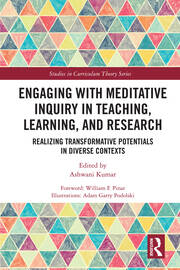
Engaging with Meditative Inquiry in Teaching, Learning, and Research Realizing Transformative Potentials in Diverse Contexts
Foreword
William F. Pinar
Introduction
Ashwani Kumar
Illustrating Meditative Inquiry
Adam Garry Podolski
Exploring the Transformative Potentials of Meditative Inquiry in Diverse Contexts
Chapter One My Journey with Meditative Inquiry: Teaching, Learning, and Researching in Law and Dispute Resolution
Nayha Acharya
Chapter Two Ruminations on Dialogue as a form of Meditative Inquiry
Vikas Baniwal
Chapter Three Exploring the Connections between Africentric Principles and Meditative Inquiry: Understanding Their Significance for Teaching and Learning in Adult Education Contexts
Susan Brigham
Chapter Four Martial Arts as Meditative Inquiry
Shawn Bullock
Chapter Five On the Significance of Meditative Inquiry in Teaching, Learning, and Living: A Dialogue Between Two Teachers
Michael Cosgrove and Shannon Power
Chapter Six Mindset and Meditative Inquiry
Adrian Downey
Chapter Seven Arts and Letters: Meditative Inquiry as Invitation
Christina Flemming
Chapter Eight Meditative Inquiry and Critical Discourse Analysis: A Hybrid Approach for Doing Educational Research
Mohamed Kharbach
Chapter Nine Meditative Inquiry as Medium for Learning: Constructing, Deconstructing, and Reconstructing Love of Self, Learning, and Life
Margaret Macintyre Latta
Chapter Ten Meditative inquiry in Dialogue with Heideggerian, Deweyan, and Buddhist Praxis
Christopher McCaw and John Quay
Chapter Eleven Synergies between Indigenous Ways of Knowing and Meditative Inquiry
Diane Obed
Chapter Twelve The Dialogic and Vulnerable Nature of Learning: Perspectives from Positive Psychology and Meditative Inquiry
Krista Ritchie and Paul Stemmler
Chapter Thirteen Meditative Inquiry and Mindfulness
David Sable
Chapter Fourteen Curriculum as Meditative Inquiry: A Poetic Response
Susan Walsh
Chapter Fifteen Structure, Consciousness, and Agency: Moving Forward Through Meditative Inquiry
Debra Wells-Hopey
Chapter Sixteen Explorations of Trauma Through Meditative Inquiry
Rajean Willis and Laura Leslie
Responses to This Collection
Meditative Inquiry: A Way Forward
Ardra Cole
Educational Research Methodology and Meditative Inquiry: Three Meditations
Michael Corbett
Becoming an ‘Unreliable’ Teacher: The Contribution of Meditative Inquiry
Anne Phelan
Meditative Inquiry and Reimagining Critical Education
E. Wayne Ross
A Queer Meditation on Meditative Inquiry
John J. Guiney Yallop
Final Comments
Contributors’ Reflections
Epilogue
Ashwani Kumar
About the Editor
About the Contributors
Index
Biography
Ashwani Kumar is Associate Professor of Education at Mount Saint Vincent University, Canada.
"Beautifully and insightfully harmonizing poetry, illustrations, autobiographical writings, and dialogic inquiry with the cross-fertilization of diverse ideas in diverse disciplines, this collection of essays illuminates how we can engage in transforming human consciousness through Ashwani Kumar’s theory of meditative inquiry to meet the challenges and crises as we face today. A timely, inspiring, creative, and evocative book for educators and researchers to educate the self while educating their students and the public!"
—Hongyu Wang, Professor of Education, Oklahoma State University (USA), author of Nonviolence and Education: Cross-cultural Pathways"This poignant book navigates the terrain to shift our relationship to teaching, learning and being through meditative inquiry. Here reflexivity and consciousness are broken open from diverse approaches to reimagine what it means to teach. This amazing multi-disciplinary collection of scholars brings not only dialogical knowledge, but more importantly, the wisdom of heart and spirit. Here is a vibrant text to companion one on a holistic path to being an educator."
—Celeste Snowber, Professor of Education, Simon Fraser University (Canada), author of Embodied Inquiry: Writing, Living and Being Through the Body"A dialogic meditative inquiry! This edited collection highlights the significance of meditative inquiry to curriculum studies and other fields. The contributors thoughtfully detail their engagements with Kumar’s scholarship on meditative inquiry from a variety of perspectives and in diverse contexts including law, Africentricity, martial arts, Indigenous wisdom, mindfulness, critical discourse analyses, arts, and post-structuralism. A timely contribution to questions of contemplative possibilities in education!"
—Claudia Eppert, Associate Professor of Education, University of Alberta (Canada), co-editor of Cross-Cultural Studies in Curriculum: Eastern Thoughts, Educational Insights"This book is a lovely progression from Ashwani Kumar’s earlier work on meditative nquiry. The unique and diverse collection of essays demonstrate how mediative inquiry can be impactful in a wide variety of contexts. This rich volume will help teachers and scholars integrate meditative inquiry into their work so that students and teachers alike can meet life with an awareness that is rooted in freedom, creativity and dialogue."
—John P. Miller, Professor of Education, University of Toronto (Canada), author of The Holistic Curriculum“Emphasizing social and relational connectedness through raising epistemological, ontological and axiological dimensions of meditative inquiry, the collected works in this book invite non-Eurocentric perspectives that challenge colonialist, neoliberal and capitalist pursuits, and offer ways to decolonize, Indigenize, and reconcile our ways of being in the world as we engage in teaching, learning, and research. Showcasing the contributions by scholars from multiple educational contexts and multi/inter-disciplinary areas, this book presents harmonizing insights that may create dialogical spaces to inquire into one’s intentions of engaging in teaching, learning and research and rejuvenate one’s relationship with self and other(ed) to reimagine and recreate a socially and ecologically just world!”
—Latika Raisinghani, In Education
“In this book, there are sixteen core chapters where educators have engaged with meditative inquiry (and with one another though peer-feedback process) from a variety of perspectives including Africentricity, Indigenous thinking, mindfulness, arts-based research, Heideggerian and Deweyan perspectives, and critical discourse analysis, among others. This book also contains illustrations by artist, teacher, and curriculum theorist Adam Garry Podolski, who has engaged with meditative inquiry through his art. In addition, I invited William Pinar to write a foreword to this book, and I sought five senior scholars from the field of education—Ardra Cole, Michael Corbett, Anne Phelan, E. Wayne Ross, and John J. Guiney Yallop—to comment on the value and significance of this book. So, the book has allowed a multi-faceted dialogue between and among scholars. I think that is what you were talking about when you asked, “How can we facilitate the dialogue?” I think the dialogue can be facilitated when we are interested in each other’s perspective.”
—Ashwani Kumar and David Sable, “A Conversation on the Edited Collection […]”, The Journal of Contemplative Inquiry
“For this reviewer, the essays in Kumar’s anthology are heartfelt, engaging, and generative. There is a sense of welcome in these writings – one which is succinctly captured in Margaret Macintyre Latta’s contribution to the collection wherein she writes, “I invite the reader to engage in this journey alongside me, bringing all of us nearer to meditative inquiry as an empowering medium for all learners / learning” (p. 123). Such spirit is echoed in the writings of fellow contributors […].”
—Giovanni Rossi, Journal of Contemplative and Holistic Education
"This wonderful collection offers exceptional contributions of diverse experiences and progressive and liberating views that describe and demonstrate how meditative inquiry as an art form can potentially transform the nature of education. This ground-breaking book is a must-read for educators from all walks of life who want to centralize intelligence, freedom, awareness, dialogue, and creativity in their classrooms and lives."
—Cherie Carter, Journal of Unschooling and Alternative Learning
