




1st Edition
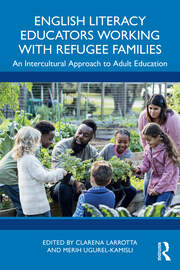
English Literacy Educators Working with Refugee Families An Intercultural Approach to Adult Education
Foreword: Experiences teaching literacy to adult refugee learners
Jeremy W. Bohonos
Chapter 1 : The need for a best practices model teaching English literacy to refugees
Clarena Larrotta and Merih Ugurel-Kamisli
Chapter 2 : U.S. refugee resettlement process, programs, and services
Shannon D. Ture
Chapter 3 : Impact of immigration policy on adult literacy teaching
Clarena Larrotta and Merih Ugurel-Kamisli
Chapter 4 : Intercultural communicative competence for refugee learners
Clarena Larrotta and Merih Ugurel-Kamisli
Chapter 5 : Community-led gardens as transformative classrooms for adult refugee English learners and families
Deborah Carter
Chapter 6 : The role of non-governmental organizations supporting adult refugees and families
Ozlem Erden-Basaran
Chapter 7 : Considerations and strategies for teaching refugee adult English learners
Jan Adversario
Chapter 8 : Curriculum overview and a best practices model working with refugee learners
Clarena Larrotta and Merih Ugurel-Kamisli
Chapter 9 : Best practices working with refugees: Concluding thoughts
Clarena Larrotta and Merih Ugurel-Kamisli
Biography
Dr. Clarena Larrotta is Full Professor in the Counseling, Leadership, Adult Education, and School Psychology Department at Texas State University, USA. Using Freirean and participatory approaches to teaching and learning, her research interests focus on adult learning, English language teaching, and adult and family literacy.
Dr. Merih Ugurel-Kamisli is Assistant Professor at TED University in Turkiye. Her research interests include English literacy, immigrant and refugee education, and social justice issues in adult education. She recently received the Alumni Engagement and Innovation Fund (AEIF) supported by the United States Department of State to provide intercultural communication training for teachers of refugees.
‘Timely and relevant topic. The number of refugees coming to the USA is daily on the news; there are very few places in the country not being affected by this phenomenon. This book includes theoretical and practical aspects, which makes it relevant to practitioners and researchers. Both undergraduate and graduate students learning about adult literacy education in general and refugee/immigrant populations in particular will also benefit. Very reader friendly! And yet based on strong theory!’
David Schwarzer, Ph.D., Montclair State University, USA
‘Issues of adult education, immigration, and literacy development are catapulted to the forefront. Blending theory and practice makes the text relevant to the transnational conditions of our times. Authors weave a collective wisdom in this highly accessible yet theoretically robust book. Focusing on refugees' and immigrants’ diverse yet personal needs, this volume provides the reader practical guidance and highly descriptive context to make it relevant to their communities' teaching, learning, and development process.’
Miguel A. Guajardo, Ph.D., Texas State University, USA
