




1st Edition
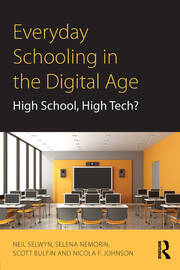
Everyday Schooling in the Digital Age High School, High Tech?
List of figures
Preface and acknowledgements
Chapter 1.Schools in the digital age... waiting for the great leap forward!
Chapter 2. Developing an everyday perspective on schools and technology
Chapter 3. Introducing the schools
Chapter 4. Leadership of technology
Chapter 5. The realities of ‘one-to-one’ technology provision
Chapter 6. New technology meets old classrooms
Chapter 7. Technology and teachers’ work
Chapter 8. Students and technology – ‘getting on’ and ‘getting by’
Chapter 9. Making sense of schools, technology and change
Chapter 10. Schools in the digital age: how might things be otherwise?
Biography
Neil Selwyn is a professor in the Faculty of Education, Monash University, Australia. His research and teaching focuses on the place of digital media in everyday life, and the sociology of technology (non)use in educational settings.
Selena Nemorin is a post-doctoral research fellow at London School of Economics and Politics (LSE), UK. Her research interests include digital sociology, philosophy of technology, Maker education, surveillance and society, and brain-machine interfaces.
Scott Bulfin is a senior lecturer in the Faculty of Education at Monash University, Australia, where he studies young people’s use of digital media and the new innovations in literacy education.
Nicola F. Johnson is an associate professor and Deputy Head in the School of Education, at Federation University Australia. Nicola’s research concerns internet over-use, the social phenomena of internet usage, technological expertise, the use of information and communication technologies within teaching and learning, and more recently, interventions with at-risk, regional students.
