





1st Edition
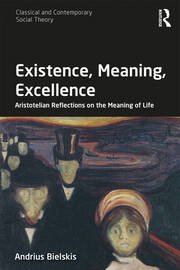
Existence, Meaning, Excellence Aristotelian Reflections on the Meaning of Life
Preface and Acknowledgements
1. European Modernity in the Light of the History of the Entropy of Meaning: A Philosophical Analysis
2. A Philosophical Critique of Existentialism
3. A Revival of Aristotelian Practical Philosophy: The Case of Alasdair MacIntyre – Practice, Unity of Life, and Tradition
4. Existence, Meaning, Excellence
5. Art as a Structure of Meaning
6. Conclusion: Modernity Reconsidered
Index
Biography
Andrius Bielskis is Professor of Political Philosophy at Mykolas Romeris University, Vilnius, and Professor of Philosophy at Kaunas University of Technology, Lithuania. He is the author of Towards a Postmodern Understanding of the Political: from Genealogy to Hermeneutics and co-editor of Virtue and Economy: Essays on Morality and Markets and Debating with the Lithuanian New Left: Terry Eagleton, Joel Bakan, Alex Demirovic, Urlich Brand.
"What is it about modernity that gives rise to a sense that life is meaningless? And how should we respond philosophically to those afflicted by that sense? Bielskis in this unusually interesting book engages in critical conversations with Schopenhauer, Camus, Habermas, Heidegger, Searle, Aristotle, and others--including me--in order to arrive at answers, answers that are sure to provoke, further disagreement. This is an exciting foray into disputed territory."
Alasdair McIntyre, University of Notre Dame, USA.
"This readable and thought-provoking book explores the responses of some celebrated European thinkers to the claim that we can no longer regard human life as having some kind of intrinsic meaning. Bielskis offers well-judged critical appraisals of the treatments of this theme by philosophers such as Nietzsche, Husserl, Heidegger, Sartre, Camus and Habermas and argues persuasively that neo-Aristotelian philosophy provides a viable answer to the questions they raise. I am happy to recommend the book to anyone with an interest in modern European thought."
Richard Stalley, University of Glasgow, UK.
"Andrius Bielskis, in this highly illuminating book, continues his research in the areas of the critique of liberalism and his further attempt to conceptualize political community and morality in Aristotelian terms. The book is well-written and relevant not only to professional philosophers but also to the general educated public. He engages in the critique of Albert Camus and Martin Heidegger and challenges a large circle of the fans of existentialism which, at least in this part of the world, is rarely questioned. At the same time, political philosophers are provoked to raise forgotten but still relevant questions about the meaningfulness of existence and excellence as the basis for political coexistence"
Agne Alijauskaite, Lithuanian Philosophical Society, 2018.
