





156 Pages
by
Routledge
156 Pages
by
Routledge
156 Pages
by
Routledge
Also available as eBook on:
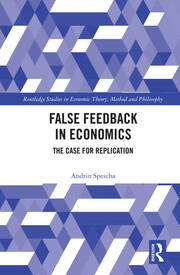
This book investigates why economics makes less visible progress over time than scientific fields with a strong practical component, where interactions with physical technologies play a key role. The thesis of the book is that the main impediment to progress in economics is "false feedback", which it defines as the false result of an empirical study, such as empirical evidence produced by a... Read more
1. Scientific Progress 2. Trial and Error 3. Conjectures and falsification 4. The garden of forking paths 5. The Duhem-Quine thesis 6. The detection of patterns 7. The illusion of true feedback 8. False feedback bubbles 9. The tree of knowledge 10. The locality of knowledge 11. Machine learning and sample splits 12. Practical experience 13. Robustness checks 14. Replication
Biography
Andrin Spescha is a postdoctoral researcher at ETH Zurich, KOF Swiss Economic Institute, Zurich, Switzerland. He received his PhD from ETH Zurich (Dr. sc. ETH) in 2018. Prior to this, he completed a Bachelor of Arts in Political Sciences and Economics and a Master of Arts in Economics at the University of Zurich, Switzerland.
