




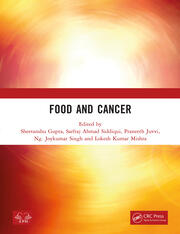
1st Edition
Food and Cancer
Preface
About the Editors
1. Dietary Intervention and Oncogenesis: Foundational Principles
Sarfraj Ahmad Siddiqui, Sheetanshu Gupta, Praneeth Juvvi, and Lokesh Kumar Mishra
2. Epidemiological Insights: Dietary Patterns and Cancer Incidence
Sheetanshu Gupta, Ng. Joykumar Singh, Sarfraj Ahmad Siddiqui and Praneeth Juvvi
3. Molecular Dialogues: Nutritional Modulators of Cellular Homeostasis
Praneeth Juvvi, Sheetanshu Gupta, Lokesh Kumar Mishra, and Sarfraj Ahmad Siddiqui
4. Chronic Inflammation and Carcinogenesis: Dietary Regulation of Inflammatory Pathways
Lokesh Kumar Mishra, Ng. Joykumar Singh, Sheetanshu Gupta, and Praneeth Juvvi
5. Nutritional Epigenetics: Dietary Influences on Gene Expression and Genome Stability
Sarfraj Ahmad Siddiqui, Sheetanshu Gupta, Ng. Joykumar Singh and Praneeth Juvvi
6. Immune Surveillance and Nutritional Immunology in Oncology
Sheetanshu Gupta, Praneeth Juvvi, Ng. Joykumar Singh and Lokesh Kumar Mishra
7. Metabolic Reprogramming in Cancer: Dietary Modulation of Tumour Bioenergetics
Praneeth Juvvi, Lokesh Kumar Mishra, Sarfraj Ahmad Siddiqui and Sheetanshu Gupta
8. The Gut Microbiome-Host Axis: Dietary Determinants in Cancer Etiology and Therapy Response
Ng. Joykumar Singh, Praneeth Juvvi, Sheetanshu Gupta and Lokesh Kumar Mishra
9. Ultra-Processed Foods and Cancer Risk: Mechanistic Insights and Public Health Implications
Sheetanshu Gupta, Praneeth Juvvi, Sarfraj Ahmad Siddiqui and Ng. Joykumar Singh
10. Phytochemicals as Chemopreventive Agents: Mechanisms of Action
Lokesh Kumar Mishra, Sheetanshu Gupta, Praneeth Juvvi and Sarfraj Ahmad Siddiqui
11. Clinical Nutritional Support in Oncological Treatment
Praneeth Juvvi, Sheetanshu Gupta, Sarfraj Ahmad Siddiqui and Lokesh Kumar Mishra
12. Post-Treatment Nutritional Strategies: Recurrence Prevention and Survivorship
Sarfraj Ahmad Siddiqui, Sheetanshu Gupta, Ng. Joykumar Singh and Praneeth Juvvi
13. Precision Nutrition in Oncology: Genetic, Lifestyle, and Individualized Approaches
Sheetanshu Gupta, Praneeth Juvvi, Lokesh Kumar Mishra and Ng. Joykumar Singh
14. Dietary Supplements in Cancer: Evidence, Efficacy, and Safety Considerations
Sarfraj Ahmad Siddiqui, Ng. Joykumar Singh, Lokesh Kumar Mishra and Sheetanshu Gupta
15. Translating Science into Practice: Constructing an Anti-Cancer Diet
Praneeth Juvvi, Lokesh Kumar Mishra, Sheetanshu Gupta, and Sarfraj Ahmad Siddiqui
16. Emerging Paradigms: Future Directions in Nutritional Oncology Research
Sarfraj Ahmad Siddiqui, Praneeth Juvvi, Sheetanshu Gupta and Ng. Joykumar Singh
Biography
Sheetanshu Gupta is Assistant Professor in Plant Biochemistry at the College of Food Technology, Central Agricultural University, Imphal, Manipur, India. He previously served as Examiner of Patents and Design in the Ministry of Commerce at the Intellectual Property Office, New Delhi, India. He earned his Ph.D. in Biochemistry in 2011 from Govind Ballabh Pant University of Agriculture and Technology, Pantnagar, Uttarakhand, India. He qualified ICAR ARS NET in Plant Biochemistry and Plant Physiology, and CSIR NET, India. His research focuses on environmental problems, aeroponics and hydroponics, protein biochemistry, tissue culture hydroponics, and mushroom farming. He has expertise in innovative farming techniques and plant protection approaches. He has published more than 35 books, more than 250 book chapters, and nearly 23 research and review papers. His work contributes to the advancement of agricultural and biochemical sciences through teaching, research, and innovative farming techniques.
Sarfraj Ahmad Siddiqui is Young Scientist in ICMR DHR at the Department of Biochemistry, King George's Medical University, Lucknow, Uttar Pradesh, India. He earned his M.Sc. in Biotechnology from Allahabad University, Prayagraj, Uttar Pradesh, India, and Ph.D. in Biotechnology with specialization in Animal Biology and Neurobiology from Babasaheb Bhimrao Ambedkar University, Lucknow, Uttar Pradesh, India, in 2018. He served as Postdoctoral Fellow at University of Lucknow, Lucknow, Uttar Pradesh, India, for three years between 2019 and 2022. He has published 8 book chapters and 12 research papers. He has presented papers at over 15 conferences, seminars, and workshops of national and international importance. He is recipient of several national and international awards for his contributions to biotechnology and biochemistry research.
Praneeth Juvvi is Assistant Professor in Food Processing Technology at the College of Food Technology, Central Agricultural University, Imphal, Manipur, India. He earned his Ph.D. in Food Technology from CSIR-Central Food Technological Research Institute, Mysuru, Karnataka, India, M.Tech. in Food Engineering and Technology from Sant Longowal Institute of Engineering and Technology, Punjab, India, and B.Tech. in Food Science from Acharya N.G. Ranga Agricultural University, Bapatla, Andhra Pradesh, India. He qualified ICAR-ASRB-NET in Food Technology in 2014 and cleared GATE examination in Engineering Sciences with All India Rank 163 in 2009 and 295 in 2011. He has over five years of research experience at CSIR-Central Food Technological Research Institute, Mysuru, Karnataka, India, where he contributed to design and development of innovative food processing equipment, process optimization for healthy snack production, and quality analysis using advanced instrumentation. He has authored multiple peer-reviewed research articles, holds a patent, and has received several best poster awards at national and international conferences. His work advances innovation and capacity-building in food technology.
Ng. Joykumar Singh is faculty member in the Agricultural Engineering Division, College of Agriculture, Central Agricultural University, Imphal, Manipur, India, since 2001. He earned his B.Tech. in Agricultural Engineering from University of Agricultural Sciences, Dharwad, Karnataka, India, in 1994, M.Tech. in Agricultural Process and Food Engineering from University of Agricultural Sciences, Bangalore, Karnataka, India, in 1996, and Ph.D. in Process and Food Engineering from Govind Ballabh Pant University of Agriculture and Technology, Pantnagar, Uttarakhand, India, in 2009. He has been actively involved in teaching, research, and extension for over 20 years. He has been granted 5 patents. He has led external aided research projects funded by Department of Science and Technology, Department of Biotechnology, and Ministry of Science and Technology, Government of India. He serves as Principal Investigator of AICRP on Post-Harvest Engineering and Technology, Central Agricultural University, Imphal, Manipur, India. He has more than 25 publications including 20 research papers in national and international journals, proceedings, book chapters, and bulletins in post-harvest technology. His research focuses on design and development of small and medium food processing machines, value addition of fruits and vegetables, and development of value-added products from locally available and underutilized fruits. He has received Distinguished Award in Agricultural Engineering, Best Centre Performance Award of AICRP-PHET, and best paper presentation awards at national seminars.
Lokesh Kumar Mishra is Professor in Biochemistry at Central Agricultural University, Imphal, Manipur, India. He earned his M.Sc. and Ph.D. in Biochemistry from Narendra Deva University of Agriculture and Technology, Faizabad, Uttar Pradesh, India. His dissertation focused on the impact of fertilizers on nutritional components of cereal crops, mainly wheat. He previously served at Narendra Deva University of Agriculture and Technology, Faizabad, Uttar Pradesh, India, and Veer Bahadur Singh Purvanchal University, Jaunpur, Uttar Pradesh, India. He has been involved in teaching biochemistry for fourteen years. He has handled research projects funded by Government of India agencies focusing on metabolic profiling of indigenous food products of North East India and development of new products utilizing biodiversity of North East India. He has authored several research papers and review articles in international and national journals. He served as DBT Overseas Visiting Associate at Department of Plant Sciences, North Dakota State University, Fargo, North Dakota, United States, where his research focused on phenolic-linked antioxidant activities of food systems for health promotion and combating metabolic syndromes including type-2 diabetes and hypertension. He received fellowship in 2019 from the International Society of Noni Science, Chennai, Tamil Nadu, India, in recognition of his work in medicinal plants and agricultural research and development.
"The book is thoughtfully structured, beginning with foundational principles of dietary intervention and tumour biology, and advancing through epidemiological insights, molecular mechanisms, inflammatory regulation, immune surveillance, metabolic reprogramming, and the gut microbiome–host interface. Each chapter synthesizes contemporary research with conceptual precision, enabling a clear understanding of how nutrients, dietary patterns, ultra-processed foods, and bioactive compounds influence cellular signalling pathways, genomic stability, oxidative stress, and tumour progression.
A distinguishing strength of the work lies in its interdisciplinary integration. The editors and contributors effectively bridge nutritional science, biochemistry, immunology, and oncology, presenting a cohesive narrative that connects population-level data with mechanistic cellular processes. The discussion remains scientifically balanced, avoiding reductionist claims while emphasizing biological complexity, dose-response relationships, and inter-individual variability. Importantly, the clinical chapters addressing nutritional support during treatment, survivorship strategies, dietary supplementation, and precision nutrition extend the book’s relevance beyond theory into applied oncological practice."— Taramla Raman, Central Agricultural University, Manipur, India.
