




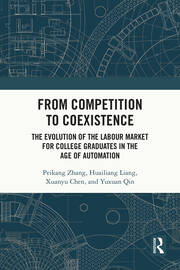
1st Edition
From Competition to Coexistence The Evolution of the Labour Market for College Graduates in the Age of Automation
List of figures
List of tables
Acknowledgments
1. Introduction
2.The Development of Robotics Globally and in China
3. The Evolution of Labour Market of Chinese College Graduates
4. Technological Anxiety: How Robots Impact College Graduates’ Informal Employment?
5. The Impact of Robot Adoption on the Demand for General Skills: Evidence Based on Job Posting Data
6. The Impact of Automation on the Demand for Specific Skills: Evidence Based on Real Interview Experience
7. Rethinking Art-Science Division Abolition: The Unforeseen Role of NCEE Reform in Preparing College Graduates for an AI-Driven Labour Market
8. The Role of Attending a Key University in Alleviating the Pressure of Artificial Intelligence Employment Substitution
9. College Majors at Risk? Insights from AI Exposure
10. Robotization and Labour Demand in Post-Pandemic Era
11. The Interplay Between Education and Economic Development: A Global Perspective
12. From Competition to Coexistence: Navigating the Future of Labor and Education in an Automated World
Index
Biography
Peikang Zhang is an assistant professor at the Institute of Higher Education and Shanghai Key Laboratory of Data Science from Fudan University. He received his Ph.D. from Peking University in 2022. His research interests include economics of education and labour economics. He is also a GLO Virtual Young Scholar in the 2023–2024 cohort and has been a GLO fellow since 2025.
Huailiang Liang is a Ph.D. candidate at the School of Education from Tsinghua University. His research interests include education policy and economics of education.
Xuanyu Chen is a master’s student at the Institute of Higher Education from Fudan University. He holds a bachelor’s degree in Educational Technology from Shanghai International Studies University. His research interests involve the economics of education, learning sciences, and artificial intelligence (AI) in education.
Yuxuan Qin is a Ph.D. candidate at the Institute of Higher Education from Fudan University. Her research interests include economics of education, AI in education, and STEM (Science, Technology, Engineering, and Mathematics) education.
“Blending rigorous research with forward-looking analysis, this book offers a timely and insightful examination of how education and policy can foster human-AI coexistence. Drawing on rich empirical evidence, it provides fresh perspectives on skill development, major selection, and labor market transitions in a rapidly evolving technological landscape. By highlighting the interplay between institutional reform and individual adaptability, the authors challenge deterministic views of automation and propose new pathways for human capital advancement. This volume is an essential resource for educators, researchers, and policymakers navigating the complexities of education and work in the age of AI.”
Professor Yuhong Du, Beijing Normal University
“This groundbreaking book redefines the future of work by shifting the narrative from fear to opportunity. Drawing on rich multi-source empirical data, it examines how college graduates adapt to the age of automation—not by resisting technological change, but by learning to coexist with it. Through detailed policy analysis and real-world labor market insights, the book provides a fresh, optimistic perspective on human-AI coexistence. An important-read for scholars, educators, and policymakers committed to understanding the evolving dynamics of education, employment, and technological disruption.”
Professor Eryong Xue, Beijing Normal University
“Uniting scholarly rigor with practical relevance, this book charts an ambitious, evidence-based path toward the joint transformation of education systems and labor markets amid accelerating technological change. Both insightful and accessible, it reframes AI not as a threat, but as a catalyst for human potential—driving adaptive learning, institutional reform, and policy innovation. Rooted in empirical evidence and enriched by interdisciplinary perspectives, it addresses the most pressing challenges of our time, equipping academics, educators, employers, and policymakers to shape an inclusive, equitable, and future-ready society.”
Professor Changjun Yue, Peking University
