




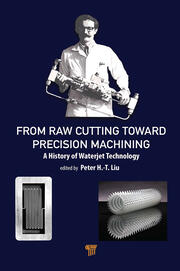
1st Edition
From Raw Cutting Toward Precision Machining A History of Waterjet Technology
PART I LEGACY OF THE FATHER OF WATERJET TECHNOLOGY
1. OMAX, MIT, and University Synergy
Alexander Slocum
2. The Legacy of Dr. John Olsen, Father of Waterjet Technology
Kathryn Pope Olsen and Carl Olsen
3. Working with Dr. John Olsen and the Evolution of High-Pressure Technology
C. “Raga” Raghavan
PART II EVOLUTION OF WATERJET TECHNOLOGY
4. Early Developments in Waterjet Technical Growth
David A. Summers
5. Early Development of AWJ Technology
M. Hashish
6. Evolution of Waterjet Technology from Raw Cutting to Precision Machining
Peter H.-T. Liu
7. Short History of Abrasive Waterjet Milling
Pete Miles
8. Modeling of Abrasive Waterjet Cutting Performance
Axel Henning
9. Particle Velocity Measurement Methods in Abrasive Water Jets
Michael Lo
10. Abrasive Waterjet and Abrasive Slurry Jet Milling of Microfeatures in Ductile and Brittle Materials
Naser Haghbin and Marcello Papini
PART III WATERJET EDUCATION
11. Waterjet Education Programs at Massachusetts Institute of Technology
Peter H.-T. Liu
12. Waterjet Education Programs at the University of British Columbia
Robin Coope, Jon Nakane, and Dylan Gunn
13. Academia and the Growth of Waterjet Technology
David A. Summers and Greg Galecki
14. The Creative Use of Waterjet in Education at the University of Sunderland
Joanne Mitchell, Colin Rennie, and Cate Watkinson
15. The Art of Waterjet Cutting
Peter H.-T. Liu
16. Waterjet Education in Japan: History, New Applications, and University Education
Guoyi Peng
17. Waterjet Education Programs in K-9 through K-14 Schools
Peter H.-T. Liu
Biography
Peter H.-T. Liu retired from OMAX Corporation in 2022. His specialty is experimental fluid dynamics. He earned his PhD from Colorado State University and held a postdoctoral fellowship at the National Center for Atmospheric Research before joining Flow Industries, where he specialized in qualitative and quantitative flow visualization in both laboratory and field settings. He later joined OMAX, where he focused on developing precision and micro-waterjet systems. Over his 50-year career, he collaborated with various institutions including PNNL, NIST, MIT, the University of Washington, Toronto Metropolitan University, National Taiwan University, and National Cheng Kung University. He has authored 2 books and over 90 technical publications and holds 11 U.S. and European patents.
“The message is versatility. What do liver surgery, glass art, egg salad sandwiches, road repair, corrosion maintenance, aircraft parts, and jewelry have in common? Waterjetting—a technology that’s everywhere but often unnoticed. My world of waterjetting focuses on cleaning, not cutting. I knew John Olsen and Peter Liu from conferences. Liu tells a different story. Dr Olsen’s idea for smaller, affordable systems fitted well with Prof. Slocum’s knowledge of precision machine design. A lunch meeting—sketched on napkins—sparked a collaboration that bridged industrial cutting and precision machining. Waterjet machining belongs to high schools, trade schools, and colleges. It offers a hands-on way to teach future engineers and artists. This book shows how one conversation helped transform an industry through teamwork and innovation. It’s an inspiring story of engineering and possibility.”
-Dr Lydia Ann Melcher Frenzel; recipient of SSPC’s 2014 John D. Keane Award of Merit and ISO 2023 Contributions Award.
“This book, besides being a definitive work on the history of waterjet machining, answered two questions that had bothered me for a long time. First: ‘Why doesn’t everyone who builds things buy a waterjet cutter?’ That it’s expensive hasn’t been valid since the OMAX ProtoMAX appeared. In business, payback matters more than price. Few machines offer better payback, especially in R&D. Second: ‘Did they try this?’ This book unusually describes not only what worked, but also what failed or had limitations—like 3D abrasive jet machining and cavitation cutting. It also shows how design methods change once you understand waterjet cutting—toward flexures, ceramics, and zero-cost registration features. For anyone intrigued by waterjet machining, this book is a gift.”
-Dan Gelbart; entrepreneur, Canada.
