




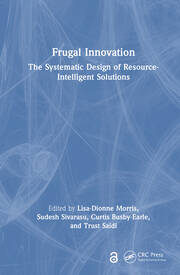
1st Edition
Frugal Innovation The Systematic Design of Resource-Intelligent Solutions
Chapter 1 Scaling Frugal Interventions across Cultures in the Fourth Industrial Revolution
Oluwamayowa O. Ogundaini
Chapter 2 Universities of the Future: “Doing More with Less” Era
Lisa-Dionne Morris and Annelie Jordaan
Chapter 3 Framework for Resource-Constrained Environments
Azael Jesus Cortes Capetillo, David Güemes Castorena, and Estefany A. Garza-Andrade
Chapter 4 A Lens for Triangulating AI in African Healthcare
Lisa-Dionne Morris, Fradreck Nyambandi, Annelie Jordaan, and Sean Miller
Chapter 5 Embedded Innovation in University Knowledge Hubs
Naita Awene and Retha de la Harpe
Chapter 6 From Silence to Solutions: Women’s Health Communication
Ajiri Ayokunle
Chapter 7 Digital Health Needs for Compromised Contexts
Faith Siva
Chapter 8 Translating the LeVe CPAP System to Uganda
Brian Matovu, Robert Ssekitoleko, Edith Namulema, Eng. Racheal Musasizi, Graham Brown, William Davis Birch, Nikil Kapur, and Peter Culmer
Chapter 9 Business and Ethics in SMEs
Engdawork Sisay Kebede
Chapter 10 Beyond Working Designs
Mika Kautonen, Mika Nieminen, and Mika Raunio
Chapter 11 Stakeholder Engagement in Under-Resourced Contexts
Mpho Kate Mholo and Retha de la Harpe
Biography
Lisa-Dionne Morris is the Director of Internationalisation, within the Faculty of Engineering and Physical Sciences at the University of Leeds, UK, and the founder of the AKTO Virtual Centre of Excellence for Frugal Innovation and Design. She is also a professor of Public and Industry Understanding of Capability-Driven Design at the University of Leeds, England, and a Strategic Design Executive Consultant of user-centred design, design engineering, and product design development. Professor Morris focuses her research and consultancy on Information Acquisition Behaviour, Interaction, and Information Systems for Organisational and Business Security—capacities to prevent, prepare for, detect, and respond to challenges. She uses capability-driven design to explore frugality, person-centered design, service, product, and system solutions that take account of users’, organisations, and stakeholders’ capabilities. Professor Morris focuses on the information needs of people in key populations (KPs) in community, business, government, and individual situations.
Sudesh Sivarasu is the DSI/NRF – SARCHi South African Research Chair in Biomedical Engineering Innovation at the University of Cape Town (UCT), where he serves as Director of the Biomedical Engineering Research Centre and head of UCT MedTech. Recognised as UCT’s prolific inventor, he holds over 65 patent applications across 21 patent families, with 26 patents granted in five countries, alongside three open-source innovations and three start-up companies originating from his work. He conceptualised the multi-award-winning FrugalBiodesign™ methodology and founded the Medical Devices Lab, as well as co-founding the Orthopaedic Biomechanics Lab, both of which have produced award-winning medical technologies. With over 50 peer-reviewed journal publications, 52 conference papers, a book, and 12 book chapters, his research focuses on developing health technologies for low-resource settings. Professor Sivarasu has received numerous accolades, including UCT’s Deputy Vice-Chancellor’s Award for Innovation, the DST Innovation Bridge Award, the NSTF-South32 TW Khambule Award for Emerging Researcher, and 16 MedTech awards across four continents. He is an elected member of the Global Young Academy (GYA) and the South African Young Academy of Science (SAYAS)
Curtis Busby-Earle is a Senior Lecturer in the Department of Computing at the University of the West Indies, Jamaica, and serves as Associate Dean in the Faculty of Science and Technology, overseeing graduate studies and research. His research interests include cybersecurity, requirements engineering, and quantum computing, and he teaches courses in cryptography, quantum computing, systems programming, and security analysis. Dr Busby-Earle developed the Software Engineering major in 2014 and the Cybersecurity major in 2025 for his department. He holds a BSc in Computer Science with a minor in Mathematics (1994) from UWI St Augustine, Trinidad and Tobago, as well as a master’s degree in Computer-Based Management Information Systems (2001) and a PhD in Computer Science (2012) from UWI Mona, Jamaica. His professional certifications include Certified Ethical Hacker (2005), Creating Computer Security Incident Response Teams (2008), and Architecture, Algorithms and Protocols of a Quantum Computer and Quantum Internet (2020).
Trust Saidi is a Postdoctoral researcher in health innovation and design at Oslo Metropolitan University, Norway. He has a Ph.D in Science & Technology Studies and an MSc in Public Policy and Human Development. His scholarly pursuits are centered on the convergence of multidisciplinary knowledge domains and diverse perspectives to orchestrate the strategic design, development, and deployment of health technologies within various community contexts. Driven by a commitment to leveraging co-creation methodologies, Trust aspires to address the intricate and multifaceted challenges inherent in healthcare by fostering collaboration among stakeholders.
