




1st Edition
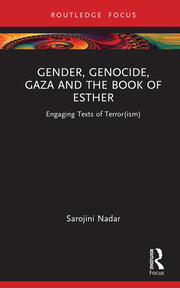
Gender, Genocide, Gaza and the Book of Esther Engaging Texts of Terror(ism)
Acknowledgements
Preface: From Persia to Palestine—Rethinking the Harem and the Herem
1. The Journey from Texts of Terror to (Con)Texts of Terrorism
2. Sacred Economies of Violence and Interpretive Communities
3. Vashti: Patriarchy, Politics, and Power
4. "Like A Virgin," Invisiblised, Invalidated, and Erased
5. Esther and Mordecai: Pretty Privilege and Theological Necropolitics
6. Esther and Haman, The Amalekite Trope: Blurring Boundaries of Self-Defence and Aggression
7. Conclusion, between the Harem and the Herem: Interpretative Practices to Counter Texts of Terror(ism)
Bibliography
Biography
Sarojini Nadar is Desmond Tutu South African Research Chair (SARChI) in Religion and Social Justice, University of the Western Cape, South Africa. The chair is bilaterally funded by the National Research Foundation (NRF) and the Lund Mission Society (LMS) under grant number: 118854. Opinions, findings, and conclusions expressed are the author's own. This monograph was made possible through research sabbatical fellowships at Wesley House, Cambridge; University of Bamberg and the Polin Institute for Theological Research at Åbo Akademi University.
