





1st Edition
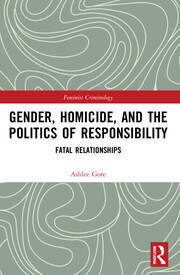
Gender, Homicide, and the Politics of Responsibility Fatal Relationships
Introduction
- Feminism, Postfeminism and the Politics of Responsibility
- Lethal Relationships and Legal Ambiguities
- Beyond the Law: Analysing Postfeminism, Emotion, and Affect in Public Responses to Lethal Violence
- Debating Men’s Responsibility for Violence
- Women’s Victimisation and Violence – The Effects of Female Individualisation
- Postfeminism, men’s rights and responsibility
Conclusion
Index
Biography
Ashlee Gore is Lecturer in Criminology at Western Sydney University. Her overarching research priority is gendered violence with a focus on violence against women and the social, cultural, and legal constructions of responsibility.
'Ashlee Gore’s fascinating book brings together important theoretical themes and frameworks to provide a unique perspective on gender, intimate homicide/violence, and the politics of responsibility. Current prominent debates about postfeminism, the gendered nature of violence, and the gendering of responsibility are all addressed in an innovative way. The original theoretical approach is applied and extended through a nuanced, thought provoking analysis of focus groups examining everyday understandings of responsibility and gender-based violence through a psychosocial lens. The inclusion of the empirical material provides an accessible and engaging insight into the importance and social relevance of Gore’s arguments. This book offers a significant contribution at the intersection of a number of fields and is a key resource for scholars and students of criminology, socio-legal studies, and gender studies/feminism.' - Dr Ana Jordan, University of Lincoln, UK
'This fascinating psychosocial analysis brings together psychoanalytic and cultural perspectives to understand homicide as gendered. A rich original study that delves into everyday accounts of blame and responsibility, showing how they are entangled with legal discourses, and shaped by assumptions that are both postfeminist and neoliberal. Will be of interest in law, criminology, and gender studies, as well as to those interested in discourse analysis and psychosocial scholarship.'
-Rosalind Gill, City, University of London
