





1st Edition
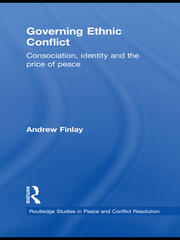
Governing Ethnic Conflict Consociation, Identity and the Price of Peace
1. Introduction 2. Anthropology, Cultural Pluralism and Consociational Theory 3. Essentialism and the Reconciliation of the Liberal State to Ethnicity 4. Is Ethnopolitics a form of Biopolitics? 5. Consociationalism as a form of liberal governmentality: ‘single identity work’ versus community relations 6. Paradigm Shifts and the Production of ‘National Being’ 7. No Exit: Human Rights and the Priority of Ethnicity 8. ‘A Long Way To Get Very Little’: the Durability of Identity, Socialist Politics and Communal Discipline 9. Conclusion
Biography
Andrew Finlay is Lecturer in Sociology at Trinity College, Dublin.
"Nowhere is the nexus between knowledge and power more starkly revealed than in conditions where, as the author rightly highlights, a line is drawn between the assumed ‘cause’ of conflict and its ‘solution’. Finlay usefully reveals the workings of this technology in a context that is not usually subjected to a Foucault-inspired analysis."
- Vivienne Jabri, Radical Philosophy, 168, July/August 2011
"Drawing upon the now vast literature on consociationalism and on two case studies - Northern Ireland and Bosnia and Herzegovina - Governing Ethnic Conflict is a valuable addition to the ever-growing literature on consociationalism and deserves a wide readership"
- Lawrence Cooley, Political Studies Review, 2011, Vol. 9
