




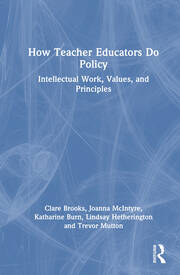
1st Edition
How Teacher Educators Do Policy Intellectual Work, Values, and Principles
Chapter One: Towards a Critical Signature Pedagogy for Teacher Education
Chapter Two: The policy context in England: reform objectives and mechanisms for change
Chapter Three: Professional learning underpinned by a Signature Pedagogy
Chapter Four: Negotiating the challenges of implementing the reform agenda: values and the implicit structure of teacher education
A Response to Chapter Four: Negotiating the challenges of implementing the reform agenda: a response from the US
Maria Teresa Tatto, Arizona State University, USA. 0000-0003-4955-1420
Chapter Five: The Pedagogy of Teacher Education: What is revealed about universities’ assumptions about the process of learning to teach?
A Response to Chapter Five: A South African perspective on responding to policy changes in teacher education
Lee Rusznyak, University of the Witwatersrand, South Africa 0000-0002-6835-8215
Chapter Six: Leaders of ITE at the nexus of relationships: Intellectual and emotional work in negotiating tensions in pedagogical approaches
A Response to Chapter Six: Navigating Complexity in ITE Leadership, A Swedish Response
Sinikka Neuhaus, Lund University, Sweden 0000-0002-7410-7391
Chapter Seven: A Shared Critical Pedagogy: Leadership, Values and Resilience in University-based ITE
Chapter Eight: Re-centring University Based Teacher Education: Towards a sector-wide critical signature pedagogy for teacher education
Biography
Clare Brooks is Professor of Education at the Faculty of Education at the University of Cambridge, UK.
Joanna McIntyre is Professor of Education at the School of Education, University of Nottingham, UK.
Katharine Burn is Associate Professor of Education at the Department of Education, University of Oxford, UK.
Lindsay Hetherington is Professor of Education at the School of Education, University of Exeter, UK.
Trevor Mutton is Professor of Education (Emeritus) at the Department of Education, University of Oxford, UK.
This is a timely and important book that speaks directly to a global moment in which teacher education is increasingly shaped by external scrutiny, policy mandates, and reductive notions of “what works.” At a time when Initial Teacher Education is being further narrowed to technical training and so-called prescribed evidence-based routines, this text powerfully reasserts the intellectual, moral, and context-sensitive nature of education. By advancing the concept of a critical signature pedagogy, it makes visible the complex, values-driven work of teacher educators and offers a compelling framework for articulating professional judgment, decision-making, and purpose in periods of reform. Particularly in light of developments such as those in England and their resonance in contexts such as Australia, this book serves as both a cautionary and generative contribution, affirming the resilience, ethical commitment, and research-informed practice of the field. It is an essential addition to the international conversation, challenging deficit narratives and advocating for a more nuanced, contextually responsive understanding of quality in teacher education.
Professor Theresa (Terri) Bourke, Queensland University of Technology (QUT), Australia
This book offers a critically refreshing insider’s view of teacher education policy across contexts. It reveals the intellectual, ethical and relational work that risks being erased when teacher education policy narrows its gaze to evidence‑based routines.
It also equips teachers and educators with a powerful language to express what truly matters for their students, and for the children they will one day teach.
In a debate that has become increasingly polarized, the authors convincingly show that quiet clarity and analytical precision can still cut through the noise.
A compelling and timely reminder that defending teacher education is not about protecting tradition, but about safeguarding the democratic foundations of teaching itself.
Professor Eline Vanassche, KU Leuven, Belgium
