





1st Edition
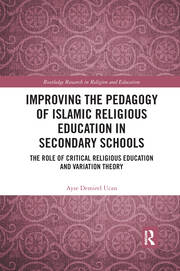
Improving the Pedagogy of Islamic Religious Education in Secondary Schools The Role of Critical Religious Education and Variation Theory
List of tables
Acknowledgements
Chapter 1
Introduction
Problems of teaching Islam in confessional and constructivist religious education
Absence of diversity in the Islamic Religious Education curriculum
A new theoretical and pedagogical approach to Islamic Religious Education
The aim of the study
Structure of the book
Chapter 2
Critical Realism and Islam
Critical Realism
Religion, God and Critical Realism
Critical Realism as applied to Islam
Critical Realism as ‘underlabouring’ Islamic Religious Education
Chapter 3
Applying the Framework of Critical Religious Education and Variation Theory to Islamic Religious Education
Critical Religious Education
Phenomenography
Variation Theory
Learning Study Model
Chapter 4
Research Methodology
Research Approach
Implementaion of learning studies
Sampling of research participants
Data collection tools
Data analysis
Ethical considerations and trustworthiness of the study
Reflexivity
Chapter 5
Implementation of Critical Religious Education and Variation Theory in RE lessons: A learning study on ‘Islam and being a Muslim’
The first lived object of learning
The intended object of learning
The enacted object of learning
The second lived object of learning
Chapter 6
Implementation of Critical Religious Education and Variation Theory in RE lessons: A learning study on ‘equality in Islam’
The first lived object of learning
The intended object of learning
The enacted object of learning
The second lived object of learning
Chapter 7
RE teachers’ pedagogical perceptions and practices before and during the learning study
Theoretical background
Themes
Chapter 8
Discussion and Conclusion
Summary and discussion of the findings
The theoretical and pedagogical implications for Islamic Religious Education
Limitations of the study
Future research
Concluding remarks
Appendices
Index
Biography
Ayse Demirel Ucan is Researcher in the Religious Education Department at Marmara University, Turkey.
