




1st Edition
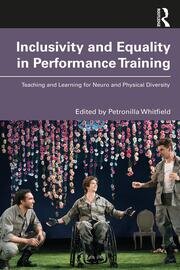
Inclusivity and Equality in Performance Training Teaching and Learning for Neuro and Physical Diversity
1. Introduction
Petronilla Whitfield
2. Acting Training and Instruction for Wheelchair-Using Artists
Regan Linton
3. Acting without Imagery: Aphantasia in the Theatre Classroom
Alexis Black, Cameron Michael Chase, Brian De Vries, Rob Roznowski
4. Twelve Steps towards an Anti-discriminatory Approach to Neurodivergence in Actor Training
Daron Oram
5. Disabling Actions and Enabling Actors: Exploring the Method of Actioning the Text for Actors with Dyslexia
Deborah Leveroy
6. Exploring Digital Technology to Enable Acting Students with Dyslexia in Their Reading of Shakespeare
Petronilla Whitfield
7. How Can Imagery, Sounds, Textures and Other Creative Mediums Help an Actor with Dyslexia Understand and Connect to Shakespeare’s Text?
Elizabeth Bartram
8. Somatic and Spatial Approaches to Essay Writing for Drama Students with Dyslexia
Jodie Allinson
9. When I Can’t ‘See You at the Theatre’: Creating Inclusive Processes for Vision-Impaired Performers
Heather May
10. Politicized Identity: Developing a Dialectical Relationship between Disability and Ability
Jo Ronan
11. ‘Embodied Voice’ and Inclusivity: Ableism and Theatre Voice Training
Tara McAllister-Viel
12. Experience as Curriculum: Developing an Intuitive, Affective, Affirmative Approach to Actor Training with (Disabled) Students
Kieran Sheehan
13. Dyspraxic Approaches to Teaching Live Art in a ‘Neurodivergent’/ ‘Normodivergent’ Classroom
Daniel Oliver and Sumita Majumdar
14. The Inclusive Drama Studio: Adaptive Strategies in University Actor Training
Rea Dennis
15. ‘See a Sign’ – Training for Deaf Actors Who Use British Sign Language as Their Preferred Language
Paula Garfield
16. Towards Equity and Agency in a Word-Dominated World: Working with Actors with Learning Disabilities
Richard Hayhow
Biography
Petronilla Whitfield is Associate Professor in voice and acting at the Arts University Bournemouth, UK. She has a PhD in arts pedagogy (Warwick University) and an MA in voice studies (Royal Central School of Speech and Drama). Trained originally as an actor at Arts Educational Schools, she was a professional actor for 20 years and has taught at leading British actor training institutions for 21 years. Her book, Teaching Strategies for Neurodiversity and Dyslexia in Actor Training, was published by Routledge in 2020. In 2020, she was awarded the Johnny Saldaña Outstanding Professor of Theatre Education Award by the American Alliance for Theatre and Education.
"One of the strengths of this book is the way it overcomes stale narratives about dis/ability and how those narratives have protected systems of exclusion and oppression for our students with varying abilities. Each chapter adds to the discourse, but could also be consulted individually, as the reader sees fit. The practical offerings make this book a successful guide to teaching inclusively in the studio, providing the reader with the power and agency to translate the research on the page into actionable revisions to their own classroom environments and teaching styles."
Kevin Kemler, Voice and Speech Review, USA
“This most recent 2021 publication draws together a powerfully experienced, pioneering, and representative group of practitioners, not only in this moment of book release, but also spanning over time as this work has progressed, interconnected, and developed. The chapters jointly and urgently progress matters of performance students and professionals being able to ‘get on’ with having so much to offer and lead on due to their passion and talent for performance training and study. […] Overall, I would highly recommend this book.”
Beth Loughran, National Drama: Drama Research Volume 14’, UK
“By including the perspectives of multiple authors across a range of settings, this volume offers diverse voices and viewpoints that come together to form a logical progressive throughline, developing a clear narrative of empowerment and equity. As a publication that advocates for and models inclusive and enabling practice through the illustrative case studies, teachers and student teachers alike will value this edited book as a useful and thought-provoking coherent collection of analytical reflections on learning and teaching in the performance studio.”
Anna McNamara, Research in Drama Education: The Journal of Applied Theatre and Performance, UK
“The book is a useful companion for all those concerned with ensuring that equality underpins pedagogical practice and, in collating case studies that discuss neurodivergent, visionimpaired, and deaf participants, the various authors offer perceptive insights into their work. Importantly Whitfield foregrounds the pedagogical concerns of delivering inclusive education and training rather than the skills or professional knowledge of instructors, something that is largely absent from current scholarship.”
James Layton, Performance Research, UK
"This is a timely volume and essential reading for practitioners, educators, and students of acting, drama and performance training. The strategies and approaches discussed have a real potential to effect positive and welcomed change. Moreover, the work has a currency beyond that of the performing professions and would be of value to readers interested in equality, diversity, and inclusion."
Shelley Piasecka, University of Chester, PARtake: The Journal of Performance as Research, UK
