





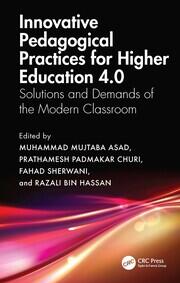
1st Edition
Innovative Pedagogical Practices for Higher Education 4.0 Solutions and Demands of the Modern Classroom
1. The Achievement of Quality 4.0 for Green Entrepreneurship Education in the Lens of Education 4.0: Digital Education Ecosystem as the Most Favorable Environment for Digital Pedagogy Implementation
Pham Quang Huy and Vu Kien Phuc
2. From Classroom to Castle: The Effectiveness of Interactive Games for Learning Maltese Prepositions
Jacqueline Żammit
3. Gamification and Digitalization in Higher Education: Enhancing Learning and Bridging the Gap in Malaysia via Lean Six Sigma Training
Hasnida Ab‑Samat, Nur Amalina Muhammad, Anis Masturina Azhan, and Muhamad Nazrin Muhd Zukri
4. Enhancement of Polya’s Problem‑Solving Skills by Gamifying Mathematics Lessons: An Experimental Study
Nadira Dayo, Muhammad Mujataba Asad, Fareed Hussain Mangi, Noor‑ul‑Ain Bhellar, and Unaeza Alvi
5. Applying Gamification as an Innovative Teaching Model with Quizalize for EFL Learners in Higher Education
Muthmainnah Muthmainnah, Ahmad Al Yakin, and Muhammad Mujtaba Asad
6. Developing 3D Games for Foreign Language Education: PV‑Hunt (Phrasal Verbs Hunt)
D. Kalay and K. Erarslan
7. Future of Writing in Higher Education: A Review of Prospective Use of Artificial Intelligence and ChatGPT in Academia
Muhammad Imran, Norah Almusharraf, and Hala Dalbani
8. An Exploratory Study on the Advantages and Disadvantages of OpenAI’s ChatGPT on Higher Education
Sahib Khatoon, Muhammad Usman Thaheem, and Habibullah Pathan
9. Quality of Distance Education in the Era of Industry 4.0 and Society 5.0: An Exploration of the Effective Frameworks and Models to Design a Criteria
Zafarullah Sahito, Noor Ahmed, and Anna‑Marie Pelser
10. Applying Artificial Intelligence to Remote Students Learning Assessment in Higher Education: Toward a New Approach Based on Information Extraction Model
G. Faouzi, N. Amrous, N. El Faddouli, and M. Khabouze
11. Zoom on the Boom: A Perspective of South East Asian ESL Teachers after Covid‑19 Situations
Muhammad Mooneeb Ali
12. Teaching–Learning through the Distance Education System: An Exploration of What, Why, and How Possibilities in the Era of Industry 4.0
Aneela Pirzado, Zafarullah Sahito, and Muhammad Kamran Abbasi
13. The Concept of Higher Education Teaching Design toward Future TVET Flexible Learning: An Analysis of Heuta‑Peera‑Cyber Approaches
M.M. Mohamad, N. Mafarja, H. Mohd Affendi, R.H. Raja Mohd. Ali, and A. Ahmad
14. Innovative Pedagogical Approaches for Sustainable Development: Implications for Business Students’ Engagement and Learning Performance in Higher Education
Song Bee Lian, Tee Poh Kiong, Wong Ling Chai, Devinder Kaur, and Liew Chee Yoong
15. Exploring the Role of AI Platforms in Improving English‑Speaking Skills in Malaysian Higher Education Institutions
Sheiladevi Sukumaran and Nurul Salwana Khair
16. Revolution in the Indian Education System from Traditional to Digital Transformation in Higher Education
Mubeen Zehra and Sukanya Singh
17. Does the Use of Digital Technologies in Education 4.0 Improve Learning Effectiveness in Higher Education in Pakistan?
Rameen Butt, Muskan Butt, and Sana Khalid
18. A Systematic Review of Multimodal Learning in Higher Education
Raja Nor Safinas Raja Harun and Amreet Kaur Jageer Singh
19. Perspective on the Evolution of Teaching Competencies for Integration in Industry 4.0 Technologies with Education 4.0
A. Sanjeev and R. Sharma
20. Critical Digital Pedagogy: A Collaborative Teaching Approach
J. Koh
Biography
Muhammad Mujtaba Asad is an Assistant Professor and Lead Researcher of Educational Technologies and TVET Research at Sukkur IBA University, Sukkur, Pakistan, and Honorary Adjunct Faculty at Sohar University, Sohar, Oman. Dr Mujtaba has national and international experience of more than 10 years in the industrial and educational sectors in educational technologies, work‑ and product‑based education, and technical and vocational education. He has published more than 85 research articles (Web of Science and Scopus Indexed) in international journals and conferences worldwide. Dr Mujtaba has authored three books with Taylor & Francis and CS Publishers. He has received three gold, one silver, and one bronze medal in international research and development completions, with seven best research awards in Malaysia, Korea, Saudi Arabia, Pakistan, and UAE on commercialized projects. Moreover, he is an active member of seven national and international research grants. Dr Mujtaba is an internationally certified educational technologist (Malaysian Board of Technologist) and holds certifications and qualifications in industrial safety and health education from NIOSH and the OSH Department of Ontario, Canada. He is an Editorial Board Member to 12 reputed and indexed international journals. Dr Mujtaba holds several international copyrights and has filed one product patent under the title of HAZFO Expert 1.0 for Drilling Operation. He was awarded an honorary lifetime International Ambassadorship by University Tun Hussein Onn Malaysia based on his academic achievements and community services. Dr Mujtaba also was awarded the title of approved PhD and MPhil/MS supervisor by the Higher Education Commission of Pakistan.
Prathamesh Padmakar Churi (SMIEEE, LMCSI, LMISTE) is a Senior member, IEEE and Independent Education Technology Researcher. He was a faculty member in the Computer Engineering Department in the School of Technology, Management, and Engineering, NMIMS University, Mumbai, India. He is an Associate Editor of International Journal of Advances in Intelligent Informatics, International Journal of Innovative Teaching and Learning in Higher Education, and International Journal of Security and Privacy. He is involved in the peer‑review process of reputed IEEE and Springer journals, such as IEEE Transactions on Education, Springer Education and Information Technologies, and 20 other journals. He has published 80+ research papers in national/international conferences and journals (Scopus and SCI Indexed), 6 Patents (including 3 Australian patents) and 5 international books (CRC Press/Taylor & Francis publications) in the field of data privacy and education technology. He has been a keynote speaker, chair, and convener at international conferences, including flagship conferences such as IEEE TALE 2017–2020, Springer ICACDS, etc. He received the Best Young Researcher Award by GISR Foundation for his research contribution in the field of data privacy and security and education technology. He has also received appreciation and best faculty awards from NMIMS University. He received a Best Reviewer Award at IEEE TALE 2020, Springer ETRD, JCHE, and Elsevier IJIM Data Insights. He is an active leader, coach, mentor, and volunteer in many nonprofit organizations. He is a Board of Study member at many universities for curriculum development and educational transformations.
Farhad Sherwani is an Assistant Professor at the National University of Computer and Emerging Sciences, Karachi, Pakistan. He has published several research articles as well as three books with Taylor & Francis and CS Publishers. Dr Sherwani was awarded the title of approved PhD and MPhil/MS supervisor by the Higher Education Commission of Pakistan.
Razali Bin Hassan is the Director of the Malaysia Research Institute for Vocational Education and Training (MyRIVET). He earned a PhD in education at the University of Warwick, UK, an MS in TVET at the University Putra Malaysia, a BE of technology with education (electrical technology) at the Malaysia University of Technology, and a Certificate of Teaching at the Technical Teachers Training College. Dr Hassan has experience as a teacher, a lecturer, a consultant, a researcher, and a motivator in various ASEAN, European, Middle Eastern, and African countries. He has published several research articles and books in educational technologies and TVET.
