





1st Edition
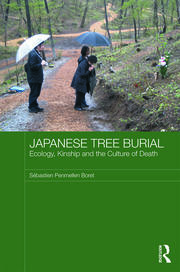
Japanese Tree Burial Ecology, Kinship and the Culture of Death
Biography
Sébastien Penmellen Boret is a research fellow at Oxford Brookes and a research associate at Oxford University. He holds currently a post-doctoral fellowship (2012-2014) at Tohoku University where he leads a project about the politics of memorialisation of the 2011 Great East Japan Tsunami and is a contributor to Death and Dying in Contemporary Japan (Routledge 2013).
"By examining innovative forms of burial and the embedded and sometimes competing and contradictory notions of the self, death, the natural world, and the world beyond, Penmellen Boret shows that innovative burial practices in contemporary Japan reveal and contribute to important transformations in Japanese society as a whole. I trust that Tree Burial will find a wide and appreciative audience." - Mark McGuire (John Abbott College) H-Shukyo, H-Net Reviews. August, 2015
"This is a rich and multi-faceted book, which explores several important social issues...Japanese Tree Burial is an interesting book, which provides fascinating ethnographic data and brings together several important topics that are not usually associated with each other. It offers some important new insights on the relationship between environmental practices, social change, and notions of death. I highly recommend it to anyone interested in contemporary Japanese society, religion, and environmental issues." - Aike P. Rots, University of Oslo, Japanese Journal of Religious Studies 42/2 (2015)
