



1st Edition
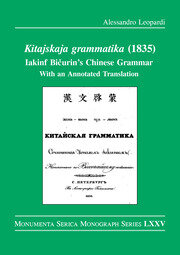
Kitajskaja grammatika (1835) Iakinf Bičurin’s Chinese Grammar (with an Annotated Translation)
Note on the Romanisation of Cyrillic Employed in the Present Work
Preface
Historical Context and Analysis: Russia’s First Grammar of Chinese
1. Introduction
2. The Diversity of Languages
3. Reassessing the Sources
4. The Bičurinian Framework
Original and Translation: Chinese Grammar (1835); On the Pronunciation of the Letters That Compose the Chinese Syllables (1839)
Translator’s Note
Hanwen qimeng 漢文啟蒙 (Chinese Grammar) Composed by
Father Iakinf, Saint Petersburg, 1835
Foreword
Part I: Containing the Basic Concepts of Chinese Language and Writing
Chapter 1: On the Chinese Language
Chapter 2: On the Classification of Sounds by Pronunciation
Chapter 3: On Chinese Writing
Chapter 4: On the Structure of Chinese Characters
Chapter 5: On the Strokes of Chinese Characters
Chapter 6: On the Different Styles of Writing
Chapter 7: On Orthography and Punctuation Marks
Chapter 8: On the Reading of Chinese Characters
Chapter 9: On Tones
Chapter 10: On the Classification of Chinese Characters
Chapter 11: On Calligraphy
Chapter 12: Supplement to the Basic Notions on Chinese Writing
Part II: Containing the Grammatical Rules of the Chinese Language
Chapter 1: On the Lack of Word Inflection in the Chinese Language and the Parts of Speech
Chapter 2: On the Noun
Chapter 3: On the Adjective
Chapter 4: On the Pronoun
Chapter 5: On Verbs
Chapter 6: On Adverbs
Chapter 7: On Prepositions
Chapter 8: On Conjunctions
Chapter 9: On Interjections
Chapter 10: On the Chinese Classification of the Parts of Speech
Chapter 11: On the Arrangement of the Full Words
Chapter 12: On the Arrangement of the Empty Words
Appendices
On the Pronunciation of the Letters That Compose the Chinese Syllables
Supplement to the Chinese Grammar, 1839
Biography
Alessandro Leopardi received his PhD in Asian and African Civilisations from Sapienza University of Rome, Italy (2020). His research focuses on contacts between the Slavic world and China, the history of Italian Sinology, and contact linguistics. He is currently a researcher in Chinese Language and Literature at the Istituto Italiano di Studi Orientali, Sapienza University of Rome.
