




1st Edition
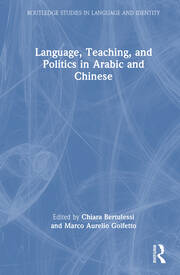
Language, Teaching, and Politics in Arabic and Chinese
Introducing the Interrelations Between Language, Teaching, and Politics: Perspectives from Arabic and Chinese
Marco Aurelio Golfetto and Chiara Bertulessi
Part 1: Language Varieties, Teaching, and Ideologies
1. Linguistic Value Orientations: Learning and Using the Standard in the Chinese-Speaking World
Minglang Zhou
2. Living in Modern Standard Arabic? Limits of an Ideology
Manuela E. B. Giolfo
3. Different Versus One Chinese Linguistic Variety to Teach: What’s Behind the Question?
Chiara Romagnoli
4. Variation in Arabic in the Light of ICT Development
Olga Bernikova
5. Putonghua and the Languages of the Minorities in China’s Language Space. A Review of Some Official Documents on China’s LPP and LEP (1999–2022)
Tommaso Pellin
6. A Radical Issue: Ishtiqāq from The Perspective of Arabic, Arab, and Islamic Linguistics
Federico Salvaggio
7. Multilingualism, Handwritten Signature, and Identity: The Case of Palestinian Multilingual Arabs in Israel
Deia Ganayim
Part 2: Politics, Teaching, and Translation
8. A Comprehensive Approach to Teaching Arabic as One Language. Insights From Dis/Continuities in Political Vocabulary
Marco Aurelio Golfetto
9. Teaching Politics to China’s Youth: A Textual and Visual Analysis of Xi Jinping Thought Textbooks
Chiara Bertulessi
10. Ideologies in Chinese Language Textbooks for Foreign Students in Mao's China
Longfei Xing
11. Translating Syrian Politics: Teaching Activities Based on Dima Wannous’s Writings
Cristina Dozio
12. Genres and Keywords in Chinese Political Language Translation. A Teaching Perspective
Bettina Mottura
13. Translating Chinese Political Language: A Case Study on Yang Jisheng’s Tombstone
Natalia F. Riva
14. The PRC’s Narratives on the Russia-Ukraine Conflict in Regular MFA Press Conferences
Tanina Zappone
Biography
Chiara Bertulessi, PhD University of Milan, is an Assistant Professor of Chinese Language and Culture at the University of Insubria, Italy. Her research, grounded in discourse analysis, explores the interconnections between language, discourse, and ideology, with a focus on contemporary Chinese political and media discourses, as well as lexicography.
Marco Aurelio Golfetto, PhD Ca’ Foscari University of Venice, teaches Arabic language and culture at the University of Milan, Italy. His research interests encompass applied linguistics and Islamic studies. He has addressed research on TAFL, heritage students’ motivation and needs, and the language of politics through corpus linguistics, topics on which he has published widely.
