





1st Edition
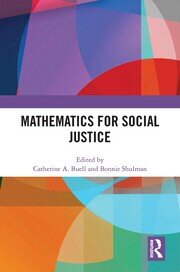
Mathematics for Social Justice
Introduction
Catherine A. Buell and Bonnie Shulman
1 Doing Social Justice: Turning Talk into Action in a Mathematics Service Learning Course
Alana Unfried and Judith Canner
2 Fighting Alternative Facts: Teaching Quantitative Reasoning with Social Issues
Mark Branson
3. Measuring Income Inequality in a General Education or Calculus Mathematics Classroom
Barbara O’Donovan and Krisan Geary
4. “There Are Different Ways You Can Be Good at Math”: Quantitative Literacy, Mathematical Modeling, and Reading the World
K. Simic-Muller
5. The Brokenness of Broken Windows: An Introductory Statistics Project on Race, Policing, and Criminal Justice
Jared Warner
6. Meaningful Mathematics: A Social-Justice-Themed-Introductory Statistics Course
jenn berg, Catherine A. Buell, Danette Day, and Rhonda Evans
7. Unnatural Disasters: Two Calculus Projects for Instructors Teaching Mathematics for Social Justice
Gizem Karaali and Lily S. Khadjavi
8. Supermarkets, Highways, and Natural Gas Production: Statistics and Social Justice
John Ross and Therese Shelton
9. Mass Incarceration and Eviction Applications in Calculus: A First-Timer Approach
Kathy Hoke, Lauren Keough, and Joanna Wares
10. Math for the Benefit of Society: A New Matlab-Based Gen-Ed Course
Paul Isihara, Edwin Townsend, Richard Ndkezi, and Kevin Tully
11. Using Graph Talks to Engage Undergraduates in Conversations Around Social Justice
Alison S. Marzocchi, Kelly Turner, and Bridget K. Druken
12. Critical Conversations on Social Justice in Undergraduate Mathematics
Nathan N. Alexander, Zeynep Teymuroglu, and Carl R. Yerger
Biography
Catherine A. Buell is Associate Professor of Mathematics. She spends her time teaching and learning from her students at Fitchburg State University, USA, and the local prison, as well as exploring the role mathematics plays in a just society. She also enjoys time with friends, the dogs, and family.
Bonnie Shulman is Professor Emerita in the Mathematics department at Bates College, Lewiston, USA. She now lives on a farm in Greene, USA, working with home-schooled youth aged 6–12 in mathematics and science.
