




Biography
Xianbai Ji is an Assistant Professor and a Distinguished Young Scholar at the School of International Studies, Renmin University of China (RUC) in Beijing.
He is also a Research Fellow at the School’s Institute of International Development, and an Associate of the European Union Centre in Singapore. He works on regionalism, geo-economics, international economic relations, economic diplomacy, and global and regional economic governance. He has published in peer-reviewed journals such as The Pacific Review, Asia Europe Journal, Pacific Focus, The Singapore Economic Review, East Asian Economic Review, and Journal of Contemporary Central and Eastern Europe. His policy-oriented articles have been published by the Council on Foreign Relations, The National Interest, The Diplomat, the German Institute for International and Security Affairs, and the Australian Institute of International Affairs, among others. His recent co-authored book China’s Belt and Road Initiative: Impacts on Asia and Policy Agenda was published in 2020 by Palgrave Macmillan. Prior to his appointment at the RUC, he held various research and visiting posts in Singapore and The Australian National University. He obtained his PhD in International Political Economy from the S. Rajaratnam School of International Studies (RSIS), Nanyang Technological University (NTU), Singapore where he was a Nanyang President’s Graduate Scholar.
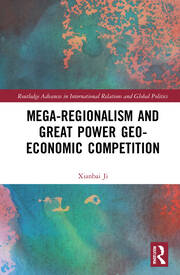
"Mega-FTA is where international economics meets international politics. It is arguably the most advanced form of regional trade liberalisation while offering great powers a seemingly economic instrument to compete against one another for global preeminence in the geopolitical sense. Xianbai offers an authoritative and innovative account of the drivers behind the formation of mega-scale trade treaties since the 2010s. This volume is a must-read for anyone interested in understanding mega-regionalism in the context of great-power competition."---Di Dongsheng, Associate Dean, School of International Studies, Renmin University of China.
“Ji Xianbai’s study of the factors driving mega-regionalism is comprehensive and innovative. He illustrates with great conceptual clarity one of the most important features driving competition and uncertainty in an increasingly rivalrous world. With many of the (geo)political processes affecting the latest phase of globalization remaining in their infancy, and with the overlapping character of normative and regulatory contestation becoming ever more manifest, this book will be useful to scholars and practitioners alike for years to come."---Zachary Paikin, Senior Visiting Fellow, Global Policy Institute (London)
"Mega-regionalism is a new trend of economic integration in the globalized world. This book examines this topical issue from a geopolitical and geo-economic perspective. It offers an excellent and empirically-rich explanation of why governments enter mega-regional trade agreements, with a particular focus on the US, China, and the EU. It surely represents an important contribution to the field of international political economy in the era of Sino-US competition and confrontation."---Chia-yi Lee, Associate Professor, Department of Diplomacy, National Chengchi University
