




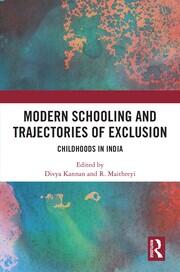

1st Edition
Modern Schooling and Trajectories of Exclusion Childhoods in India
Introduction—Modern Schooling and Trajectories of Exclusion: Childhoods in India
R. Maithreyi and Divya Kannan
1. Reframing “inclusion”: On the “marginal Child” and the “subaltern student”
Sarada Balagopalan
2. Migrant childhoods and schooling in India: contesting the inclusion-exclusion binary
Vijitha Rajan
3. Decontextualized schooling and (child) development: Adivasi communities’ negotiations of early childhood care and education and schooling provisions in India
R. Maithreyi, Ketaki Prabha and Arun Viknesh
4. Contesting the secular school: everyday nationalism and negotiations of Muslim childhoods
Shaima Amatullah
5. Clean bodies in school: spatial-material discourses of children’s school uniforms and hygiene in Tamil Nadu, India
Smruthi Bala Kannan
6. Inclusive education in practice: disability, ‘special needs’ and the (Re)production of normativity in Indian childhoods
Kim Fernandes
7. Constructions and contestations of Indigenous girlhoods in residential schools in Central India
Rashmi Kumari
8. Caste, space, and schooling in nineteenth century South India
Divya Kannan
Conclusion
R. Maithreyi and Divya Kannan
Biography
Divya Kannan is Assistant Professor, Department of History and Archaeology, Shiv Nadar Institution of Eminence, India, and focuses on Histories of Childhood and Youth in South Asia.
R. Maithreyi is Strategic Lead - Adolescent Health Thematic, at Karnataka Health Promotion Trust, India. Her work spans the areas of childhood and youth, intervention, and research.
“Empirically rich and theoretically astute, this book offers brilliant insights into the construction and contestation of childhood in India. Focusing on children’s negotiations of the normative structures and practices of schooling, the authors shine a light on the persisting forms of exclusion that are experienced particularly by the most marginalized. Rarely does a book succeed in offering such range and depth of scholarly analysis, attentive to both the ethics of researching children’s lives and the politics of institutions that attempt to condition them. This is an unparalleled contribution to studies of childhood in India and globally.”
Arathi Sriprakash, University of Bristol, UK
“This important collection explores the institutional practices found within compulsory schooling in the (re)constitution of normative categories of childhood. Underpinned by rich archival and ethnographic research, the eight chapters lay bare how non-normative childhoods across an array of geographical contexts in India remain excluded by legislation that purports to promote an inclusive education. In doing so, this foregrounds questions of how (and, more importantly, why), in spite of policy commitments for the inclusion of marginalised children, formal schooling in India continues to privilege the normative ‘child’: that is, children who are predominantly male, upper class and upper caste. Without doubt, this extremely timely book represents a critical contribution to contemporary debates around multiple childhoods and the politics of educational exclusion.”
Peggy Froerer, Brunel University London, UK
