





1st Edition
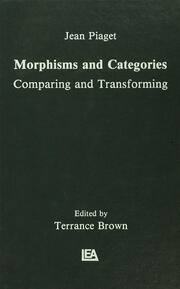
Morphisms and Categories Comparing and Transforming
252 Pages
by
Psychology Press
252 Pages
by
Psychology Press
252 Pages
by
Psychology Press
Also available as eBook on:
Despite dissent in many quarters, Piaget's epistemology and the developmental psychology derived from it remain the most powerful theories in either field. From the beginning, Piaget's fundamental epistemological notion was that all knowledge is rooted in action, and for a long time, he identified action with transformation. What is known is that which remains constant under transformatory action.... Read more
Contents: T. Brown, About the Translation. S. Papert, Preface. With Cl. Monnier, J. Vauclair, Rotations and Circumductions. With D. Voelin-Liambey, I. Berthoud-Papandropoulou, The Composition of Two Cyclic Successions. With A. Moreau, The Rotation of Cubes. With I. Fluckiger, M. Fluckiger, Compositions and Conservation of Lengths. With E. Marti, E. Mayer, The Composition of Differences. With H. Kilcher, J.P. Bronckart, The Sections of a Parallelepiped and a Cube. With C. Bruhlhart, E. Marbach, Correspondences of Kinships. With A. Karmiloff-Smith, A Special Case of Inferential Symmetry: Reading a Road Map Upside Down. With A. Karmiloff-Smith, Conflicts Among Symmetries. With Cl. Voelin, E. Rappe-du-Cher, Correspondences and Causality. With F. Kubli, Equilibrium of Moments in a System of Coaxial Disks. With A. Blanchet, E. Ackermann-Vallad o, Comparison of Two Machines and Their Regulators. G. Henriques, Morphisms and Transformations in the Construction of Invariants. E. Ascher, The Theory of Categories and Genetic Epistemology. General Conclusions.
Biography
Edited by Terrance Brown, Authors Jean Piaget; Gil Henriques; Edgar Ascher
"...develops a novel interpretation of the construction of knowledge. It is a collaborative and interdisciplinary study, including contributions from three mathematicians with an expertise in category theory".
—British Journal of Developmental Psychology"... offers a rich description of one of the most interesting attempts to use a very sophisticated form of the continuity hypothesis as a guide to experimentation."
