




1st Edition
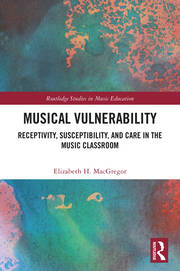
Musical Vulnerability Receptivity, Susceptibility, and Care in the Music Classroom
1. Introducing musical vulnerability: Policy, pedagogy, and phenomenology
2. Inherent musical vulnerability: Music’s semantic and somatic properties
3. Situational musical vulnerability: Music’s institutional and interpersonal mediation
4. Characterising pupils’ musical vulnerability
5. Characterising teachers’ musical vulnerability
6. Observing musical vulnerability: East Fen High School
7. Experiencing musical vulnerability: Ethan, Greg, Iniya, and Juliette
8. Harnessing musical vulnerability: Implications and conclusions
Biography
Elizabeth H. MacGregor is currently the Joanna Randall- MacIver Junior Research Fellow at Somerville College, University of Oxford. She holds a PhD in music education from the University of Sheffield.
‘An important contribution to critical music education studies, this book outlines new directions for theorising music education, most notably the concept of musical vulnerability. As MacGregor eloquently demonstrates, it is because people have powerful positive experiences of music that they can also have very strong negative experiences, and music education policy and practice must take this fundamental truth into account. As such, this book will be eagerly read by both music and education scholars internationally.’
—Anna Bull, University of York, United Kingdom
‘With insightful examples and theoretical depth, Musical Vulnerability compellingly departs from the celebratory narratives of music for individual and social betterment to insist upon a more nuanced perspective on school music education. A thought-provoking impetus to reshape music education policy, practice, and research in compassionate, relational, and ethical ways.’
—Alexis Anja Kallio, Queensland Conservatorium Griffith University, Australia
‘Grounded in solid empirical work and rigorously theorised, Musical Vulnerability offers a provocative challenge to the belief that the teaching of music is without risks. Drawing attention to music’s semantic and somatic qualities, MacGregor argues compellingly for the importance of a “pedagogy of vulnerability”.’
—Roger Mantie, University of Toronto, Canada
