




1st Edition
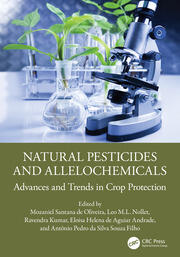
Natural Pesticides and Allelochemicals Advances and Trends in Crop Protection
Section 1: Pest Management—Sustainability Versus Unsustainability—Allelochemicals
1. Synthetic Pesticides and Sustainable Food Products
Elson Santiago Alvarenga, Cristiane Isaac Cerceau, and Vitor Cunha Baia
2. Toxicity of Chemical and Biological Plant Protection Products to Agriculture
Hamdy A. Shaaban and Mohamed H. Soliman
3. Effect of Pesticides on Environment and Health
Sushila Arya, Sonu Kumar Mahawar, Himani Karakoti, Mozaniel Santana de Oliveira, Ravendra Kumar, and Om Prakash
4. Natural and Synthetic Chemical Products: Protection and Safety, Toxicity in Crops
Marcilene Paiva da Silva, Karyme do Socorro de Souza Vilhena, Fábio José Bonfim Cardoso, et al.
5. Allelochemicals and Signaling Compounds in the Plant Kingdom: Interactions and Functions
Showket Ahmad Dar, Ayah Talal Abdullah Al-Kilani, Ammar AL-Farga, et al.
6. Pest Management in Agriculture: Chemical and Biological Methods
Shivang Joshi, Sakshi Negi, Pooja Bargali, et al.
Section 2: Essential Oils and Allelochemicals
7. Allelochemical Approaches and Phytotoxic Potential of Essential Oils
Oberdan Oliveira Ferreira, Celeste de Jesus Pereira Franco, Márcia Moraes Cascaes, et al.
8. Essential Oils as Potential Integrated Pest Management Strategies
Marcilene Paiva da Silva, Karyme do Socorro de Souza Vilhena, Eliza de Jesus Barros dos Santos, et al.
9. Antimicrobial Activity of Essential Oils: Uses and Applications Against Plant Pathogens
Arley Rey Páez and João Paulo Viana Leite
Section 3: Pesticides Based on Natural Products
10. High-Throughput Screening to Detect Natural Compounds with Pesticidal Properties
Luis C. Vesga, Jonathan Lara-Sanchez, Gloria Stefany Avendaño-Mora, et al.
11. Microbe-Based Pesticides: Promising Alternative to Chemical Pesticides
Saranya R, Amrutha Lakshmi M, and Ritu Mawar
12. Phenylpropanoids as Potential Natural Pesticides
Karyme do Socorro de Souza Vilhena, Fábio José Bonfim Cardoso, Leonardo Souza da Costa, et al.
13. Terpenes and Terpenoids: Potential Alternatives for the Control of Weeds
Hamdy A. Shaaban and Mohamed H. Soliman
14. Traditional Knowledge and the Development of Botanical Biocides in Brazil for the Control of Aedes aegypti
Paula Maria Correa de Oliveira, João Paulo Barreto Sousa, Lorena C. Albernaz, et al.
15. Azadirachtin from Neem (Azadirachta indica): Efficacy and Mechanisms Against Insects and Diseases
Abdulrahman A. Almadiy, Mariam S. Al-Ghamdi, Fahd Mohammed Abd Al Galil, et al.
Section 4: Natural Herbicides
16. Terpenes and Terpenoids as a Sustainable Alternative for Weed Control
Mozaniel Santana de Oliveira, Karyme do Socorro de Souza Vilhena, Marcilene Paiva da Silva, et al.
17. Microbial Herbicides
Alan K. Watson
18. Fungal Biopesticides and Their Uses for Control of Insect Pests and Diseases
Deepak Kumar, M. K. Singh, Hemant Kumar Singh, et al.
19. Allelopathy: A Green Sustainable Weed Management Approach
Puneet Kaur, SS Rana, Avnee, et al.
Section 5: Seaweeds and Vermicompost
20. Marine Products: Key Source for Novel Pesticidal Agents
Himani Karakoti, Tanuja Kabdal, Pooja Bargali, et al.
21. Sustainable Agriculture Practices: Impact of Vermicompost on Soil Health and Ornamental Plant Production
Saiqa Andleeb, Isra Shafique, and Irma Liadqat
Biography
Dr. Mozaniel Santana de Oliveira graduated in Chemistry from the Federal University of Pará, Brazil. He obtained both a master’s and Ph.D. in Food Science and Technology from the same university. From 2010 to 2014, he worked on the chemistry of natural products at the Empresa Brasileira de Pesquisa Agropecuária (Embrapa), and from 2014 to 2018, he worked in the Postgraduate Program in Food Science and Technology at the Federal University of Pará, Brazil. Since 2020, he has been a researcher for the Institutional Training Museu Paraense Emilio Goeldi, Brazil. Currently, doing a Postdoctoral Internship in Biological Sciences at the same institution. He has published 9 books, 100 research articles, and 50 book chapters.
Prof. Leo M.L. Nollet earned his PhD in 1978 in biology from the Katholieke Universiteit, Leuven, Belgium. He is an editor and associate editor of more than 50 books. He has edited for CRC Press of Taylor & Francis Group the first, second, and third editions of Food Analysis by HPLC and the Handbook of Food Analysis, a two-volume set. Dr. Nollet also edited the first, second, and third editions of the Handbook of Water Analysis and the third and fourth editions of Chromatographic Analysis of the Environment. With Fidel Toldrá, he co-edited a series of animal product-related books. Dr. Nollet has co-edited with Y. H. Hui and other colleagues several other books. With Hamir Rathore, he worked on 4 books about pesticides. In the series Food Analysis and Properties, he has edited more than 15 books. New volumes are in preparation for this series.
Dr. Ravendra Kumar is an Assistant Professor in the Department of Chemistry, at G.B. Pant University of Agriculture and Technology, India. He has published over 70 research papers in reputable journals, 12 book chapters in pesticide chemistry and natural products, and 4 review articles in plant chemistry. In 2018 he received the Young Scientist Award from the Society for Himalayan Action Research and Development.
Dr. Eloisa Helena de Aguiar Andrade is an Associate Researcher at the Museu Paraense Emílio Goeldi, Brazil, and an Adjunct Professor at the Faculty of Chemistry at the Federal University of Pará, Brazil. She has authored over 500 scientific contributions, including articles, book chapters, and books. She has experience in the field of chemistry, with an emphasis on the chemistry of natural products.
Dr. Antônio Pedro da Silva Souza Filho is a Researcher at the Brazilian Agricultural Research Corporation, Embrapa Amazônia Oriental. He has experience in Chemical Ecology, working mainly on allelopathy, production of agricultural biodefensives, and increased biodefensive activity of chemical substances.
