





1st Edition
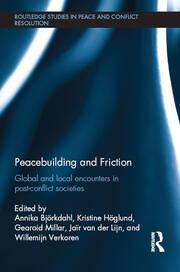
Peacebuilding and Friction Global and Local Encounters in Post Conflict-Societies
Introduction: Peacebuilding through the lens of friction, Annika Björkdahl, Kristine Höglund, Gearold Millar, Jaïr van der Lijn, and Willemijn Verkoren 1. Frictional spaces: Transitional justice between the global and the local, Susanne Buckley Zistel 2. Respecting complexity: Compound friction and unpredictability in peacebuilding, Gearoid Millar 3. Frictional commemoration. Local agency and cosmopolitan politics at memorial sites in Bosnia-Herzegovina and Rwanda, Johanna Mannergren Selimovic 4. Escaping Friction: Practices of creating non-frictional space in Sierra Leone, Lise Philipsen 5. Sites of Friction: Governance, identity and space in Mostar, Annika Björkdahl and Ivan Gusic 6. The imagined agent of peace: Frictions in peacebuilding through civil society strengthening, Willemijn Verkoren and Mathijs van Leeuwen 7. Friction over justice in post-war Sri Lanka: Actors in local-global encounters, Kristine Höglund and Camilla Orujela 8. The ‘awkward’ success of peacebuilding in Cambodia – creative and incomplete, unsustainable yet resilient, progressing but stalling, Joakim Öjendal and Sivhuoch Ou 9. Frictions in illusionstan: Engagement between the ‘global’ and the ‘local’ in Afghanistan’s imagi-nation-building, Jair Van der Lijn 10. Connections for peace: Frictions in peacebuilding encounters in Ituri, Democratic Republic of Congo, Sara Hellmuller 11. Problematising global-local dynamics in Timor-Leste, Maria Raquel Freire and Paula Duarte Lopes Conclusions: Peacebuilding and the significance of friction, Annika Björkdahl, Kristine Höglund, Gearold Millar, Jaïr van der Lijn, and Willemijn Verkoren
Biography
Annika Björkdahl is Professor in the Department of Political Science, Lund University, Sweden, and author of The Quest for Just Peace in the Middle East and the Western Balkans (2013, Routledge).
Kristine Höglund is Professor in the Department of Peace and Conflict Research, Uppsala University, Sweden and is co-editor of Understanding Peace Research (2011, Routledge).
Gearoid Millar is Lecturer in Sociology at the University of Aberdeen, UK, and author of An Ethnographic Approach to Peacebuilding (2014, Routledge).
Jaïr van der Lijn is Senior Researcher at the Stockholm International Peace Research Institute (SIPRI), Sweden.
Willemijn Verkoren is Associate Professor and Director of the Centre for International Conflict Analysis and Management (CICAM) at Radboud University Nijmegen, the Netherlands.
‘This important volume adds a new dimension to the study of peacebuilding, in the light of recent work on power-relations, hybridity, and the local turn. The notion of 'friction' allows for a more detailed and sensitive understanding of their complex interplay, drawing in new disciplinary matters, foregrounding the overwhelming significance of the subjects of peace and their daily ethico-political struggle, and throwing new light on current policy practices. This volume will stimulate new thinking about peace in the contemporary era.’ -- Oliver Richmond, University of Manchester, UK
‘For some time, debates on international efforts to build peace have been stuck in an intellectual quagmire around "hybrid" political orders. This volume is the first to break out of this now stale debate to offer new conceptual and evidence-oriented analysis of peacebuilding with a fresh conceptual approach of "friction". In studies of key cases such as Afghanistan, Cambodia and Timor-Leste, combined with insightful thematic analysis of transitional justice and civil society, the contributors to this excellent volume provide a significant new contribution to the peacebuilding field.’ -- Timothy Sisk, University of Denver, USA
‘This interesting and very useful book combines theoretical and empirical analyses of post-conflict peacebuilding to advance our understanding of local ownership and hybridity. It accounts for the complexity of global and local efforts with a nuanced and fresh lens. A must read!’ -- Thania Paffenholz, Graduate Institute of International and Development Studies, Geneva, Switzerland
