




1st Edition
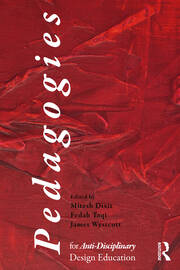
Pedagogies for Anti-Disciplinary Design Education
Introduction: Why Anti-Disciplinarity?
Mitesh Dixit, Fedah Taqi, James Westcott
1. Everything Is in Everything: Panecastic Method and Border Pedagogy in the Architectures
Tim Waterman
2. Starting Over: Integrating Ecological Feminist Materialist Approaches in Architectural Conservation and Landscape Pedagogy
Sonal Mithal and Chandrani Chakrabarti
3. Yes, and: Interstices as a Living Laboratory for Anti-Disciplinary Design
Elena Tudela Rivadeneyra and Daniel Daou
4. Designing the Encounter with the Other: Toward an Affective Pedagogy of Creativity and Collective Imagination
Mauro Gil-Fournier Esquerra
Roundtable 01: Beginnings of an Alternative Pedagogical Project: Conversations on Situated Methods and Institutional Critique to Rethink Design Education
Politecnico di Torino, January 16-17, 2025
5. Design Before Discipline: Scrappy Methods for a Contemporary Landscape Architecture Education
Mariel Collard Arias and Mark Heller
6. Anti-Disciplinary Interdisciplinarity: Uselessness in a Polytechnic Architecture School
Richard Lee Peragine and Camillo Boano
7. Memoir Carnivals: Anarchitecture and Collective Pedagogies from Disciplinary Borders
Francisco Vergara-Perucich
8. Re-Creating the Past: Imagination, Heritage, and Anti-Disciplinary Pedagogies in Architecture
Kalandar Kamalkhan
Roundtable 02: Advancing Anti-Disciplinary Pedagogies: Refining and Building the Book
University of Greenwich, March 21, 2025
9. Immersive Horizons: Virtual Reality-Mediated Pedagogical Explorations for Anti-Disciplinary Architectural Design at Tsinghua University
Shiyu Wei and Sisi Liang
10. Architecture after Discipline: Learning from Productive Failures and Situated Pedagogies
Mitesh Dixit and Fedah Taqi
11. Heavy, Weight: Tapestries as Pedagogical Practices
Ed Wall
Afterword: Toward a Definition and an Ethics of Anti-Disciplinarity
Mitesh Dixit, Fedah Taqi, James Westcott
Biography
Mitesh Dixit is an architect, geographer, and founder of DOMAIN Office. His work connects architectural practice with critical research, focusing on territorial changes, extractive industries, and the geopolitics of the built environment. He teaches at several universities in the U.S., the U.K., and Europe, and publishes on architecture, geopolitics, and extractive landscapes, integrating design with critical cartographical analysis.
Fedah Taqi is a junior designer at BIG in New York. Her prior work as a Project Designer at DOMAIN Office included projects in the U.S., teaching in Serbia and Austria, and curatorial research in Italy; her recent work studied socio-spatial conditions along MENA borders.
James Westcott is an editor and writer. He taught a studio on material reuse with Rotor at the Architectural Association in London and continues to teach a seminar on (nature) conservation. He is currently editing Rem Koolhaas’s upcoming autobiography (Taschen, 2026) and edited Ad Hoc Baroque (Rotor, 2023), Back to the Office (Nai010, 2022), Countryside (Taschen, 2020), Elements of Architecture (Taschen, 2018), and Project Japan (Taschen, 2011). He is the author of When Marina Abramović Dies (MIT Press, 2010).
