





1st Edition
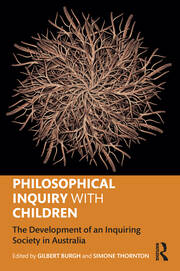
Philosophical Inquiry with Children The Development of an Inquiring Society in Australia
About the Editors
List of Contributors
Acknowledgements
EDITORIAL INTRODUCTION
The Philosophical Classroom: An Australian Story Gilbert Burgh & Simone Thornton
PART I: THE DEVELOPMENT OF PHILOSOPHY FOR CHILDREN IN AUSTRALIA
Introduction Gabrielle Mardon
Chapter 1. Philosophy for Children Comes to Australia Laurance J. Splitter & Jennifer Glaser
Chapter 2. Getting Started: The Early Use of the IAPC Curriculum Jennifer Glaser & Anita Bass
Chapter 3. The Federation Debate: Creating an Australasian Network Laurance J. Splitter & May Leckey
Chapter 4. From Newsletters to An Australasian Journal and Beyond Stephan Millett
Chapter 5. Australian Practices Go Overseas Megan Jane Laverty
PART II: IDEAS INTO BOOKS
Introduction Gabrielle Mardon
Chapter 6. ‘Memo to Harry Stottlemeier And Friends: You Are Not Wanted Here’. Reflections on The Idea of a Philosophy Curriculum in Australia Laurance J. Splitter
Chapter 7. What’s So Special About A Story? Revisiting the IAPC Text-As-Story Paradigm Jennifer Glaser
Chapter 8. Resourceful Teachers and Teacher Resources Susan Wilks
Chapter 9. From Picture Books to Science in The Classroom Tim Sprod
Chapter 10. Writing for Children and Teachers: A Philosophical Journey Philip Cam
Chapter 11. Connecting Concepts and Developing Thinking Classrooms Clinton Golding
PART III: PHILOSOPHY IN SCHOOLS
Introduction Gabrielle Mardon
Chapter 12. Teacher Education and Professional Development Janette Poulton
Chapter 13. Philosophy and The Curriculum Monica Bini, Peter Ellerton, Sue Knight, Stephan Millett & Alan Tapper
Chapter 14. Philosophy in Schools Across Australia Kate Kennedy White with Liz Fynes-Clinton, Lynne Hinton, Jill Howells, Emmanuel Skoutas, Daniel Smith & Matthew Wills.
Chapter 15. Philosophy in Public and Other Educational Spaces Selena Prior & Susan Wilks
Chapter 16. Australian Research into The Benefits of Philosophy for Children Stephan Millett, Rosie Scholl & Alan Tapper
Chapter 17. Philosophy for Children Goes to University Jennifer Bleazby & Christina Slade
REFLECTIONS
Chapter 18. Growing Up with Philosophy in Australia: Philosophy as a Cultural Discourse Simone Thornton & Gilbert Burgh
Tributes
Index
Biography
Gilbert Burgh is Senior Lecturer in the School of Historical and Philosophical Inquiry at the University of Queensland, Australia. He is the founder of the Queensland Association for Philosophy in Schools and has published widely on democratic education, citizenship, ethics and dialogic inquiry.
Simone Thornton teaches Philosophy in the School of Historical and Philosophical Inquiry at the University of Queensland, Australia. Her area of specialisation is environmental education, and her publications range from Albert Camus and education, to the role of genuine doubt in collaborative philosophical inquiry.
"Two elements regarding the construction of the argument of this book are what makes the book of great value to readers beyond Australia and beyond philosophy for children. First, each chapter is a combination of personal stories integrated with educational, philosophical and pedagogical theory that simultaneously focuses on P4wC and COI and broader educational and cultural issues. The second advantage of the structure of the book is the different vantage points of the authors." - Richard Morehouse, Journal of Didactics of Philosophy
"This book offers a robust and refined picture of P4C to anyone keen to understand how P4C fits into a specific educational, cultural, and political context. Its contribution is particular timely and important for some countries that try to employ a wholistic approach to P4C intended to create a more supportive environment for P4C practitioners. This book offers a good starting point to realise not only an inquiring school community but an inquiring society/world." - Kei Nishiyama, Philosophical Inquiry in Education
