




1st Edition
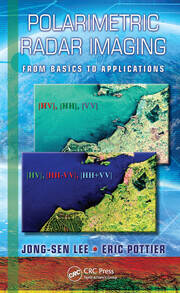
Polarimetric Radar Imaging From Basics to Applications
Overview of Polarimetric Radar Imaging
Brief History of Polarimetric Radar Imaging
SAR Image Formation: Summary
Airborne and Space-Borne PolSAR Systems
Description of the Remaining Chapters
Electromagnetic Vector Wave and Polarization Descriptors
Monochromatic Electromagnetic Plane Wave
Polarization Ellipse
Jones Vector
Stokes Vector
Wave Covariance Matrix
Electromagnetic Vector Scattering Operators
Polarimetric Back Scattering Sinclair S Matrix
Scattering Target Vectors k and Omega
Polarimetric Coherency T and Covariance C Matrices
Polarimetric Mueller M and Kennaugh K Matrices
Change of Polarimetric Basis
Target Polarimetric Characterization
PolSAR Speckle Statistics
Fundamental Property of Speckle in SAR Images
Speckle Statistics for Multilook-Processed SAR Images
Texture Model and K Distribution
Effect of Speckle Spatial Correlation
Polarimetric and Interferometric SAR Speckle Statistics
Phase Difference Distributions of Single-Look and Multilook PolSAR Data
Multilook Product Distribution
Joint Distribution of Multilook Si2 and Sj2
Multilook Intensity and Amplitude Ratio Distributions
Verifications of Multilook PDFs
K Distribution for Multilook Polarimetric Data
Summary
Appendices
PolSAR Speckle Filtering
Introduction to Speckle Filtering of SAR Imagery
Filtering of Single Polarization SAR Data
Review of Multipolarization Speckle Filtering Algorithms
PolSAR Speckle Filtering
Scattering Model-Based PolSAR Speckle Filter
Introduction to the Polarimetric Target Decomposition Concept
Introduction
Dichotomy of the Kennaugh Matrix K
Eigenvector-Based Decompositions
Model-Based Decompositions
Coherent Decompositions
The H/A/a Polarimetric Decomposition Theorem
Introduction
Pure Target Case
Probabilistic Model for Random Media Scattering
Roll Invariance Property
Polarimetric Scattering a Parameter
Polarimetric Scattering Entropy (H)
Polarimetric Scattering Anisotropy (A)
Three-Dimensional H/A/a Classification Space
New Eigenvalue-Based Parameters
Speckle Filtering Effects on H/A/a
PolSAR Terrain and Land-Use Classification
Introduction
Maximum Likelihood Classifier Based on Complex Gaussian Distribution
Complex Wishart Classifier for Multilook PolSAR Data
Characteristics of Wishart Distance Measure
Supervised Classification Using Wishart Distance Measure
Unsupervised Classification Based on Scattering Mechanisms and Wishart Classifier
Scattering Model-Based Unsupervised Classification
Quantitative Comparison of Classification Capability: Fully PolSAR versus Dual- and Single-Polarization SAR
Pol-InSAR Forest Mapping and Classification
Introduction
Pol-InSAR Scattering Descriptors
Forest Mapping and Forest Classification
Appendix
Selected PolSAR Applications
Polarimetric Signature Analysis of Manmade Structures
Polarization Orientation Angle Estimation and Applications
Ocean Surface Remote Sensing with PolSAR
Ionosphere Faraday Rotation Estimation
PolSAR Interferometry for Forest Height Estimation
Nonstationary Natural Media Analysis from PolSAR Data Using a Two-Dimensional Time-Frequency Approach
Appendix A: Eigen Characteristics of Hermitian Matrix
Appendix B: PolSARpro Software: The Polariemtric SAR Data Processing and Educational Toolbox
Index
Biography
Lee, Jong-Sen; Pottier, Eric
"… This very concise book covering basics to applications will serve as a fundamental hands-on book for years to come. … we congratulate the authors for their diligence, oversight, and sincere dedication for assembling such a well-organized and long overdue book on the basics and applications of polarimetric radar imaging. …"
—Wolfgang-Martin Boerner, University of Illinois, Chicago, USA
