




1st Edition
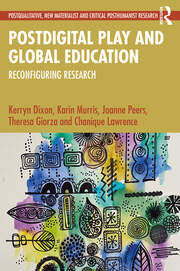
Postdigital Play and Global Education Reconfiguring Research
Preface Candace Kuby
Foreword Luzia Souza and Heloisa Silva
Chapter 1: Storying the Children, Technology and Play (CTAP) Project
Chapter 2: The ‘post’ in postdigital play
Chapter 3: Playing with Lenses: from ‘Object’, to ‘Subject’, to ‘Phenomenon’
Chapter 4: Reconfiguring transcription in educational research
Chapter 5: Reconfiguring research sites as worldmaking practices
Chapter 6: Reconfiguring agency and creativity in young children’s postdigital play
Chapter 7: Tentacular moves for postdigital research
References
Index
Biography
Kerryn Dixon is Associate Professor at the University of Nottingham, UK. Her teaching and research are in the field of language and literacy studies, specialising in early literacy and critical literacy. She is particularly interested in the interrelationships between language, literacy, and power in contexts of poverty.
Karin Murris is Professor of Early Childhood Education at the University of Oulu, Finland, and Emerita Professor of Pedagogy and Philosophy, University of Cape Town, South Africa. She is a teacher educator, grounded in academic philosophy and a postqualitative research paradigm. Her main interests are in posthuman child studies, philosophy in education, ethics, and democratic pedagogies. Website: www.karinmurris.com.
Joanne Peers is a PhD candidate at The University of Oulu, Finland, pursuing relationality in environmental education through thinking with bodies and water. Her interest in justice in the global south is woven through her role as Head of Academics at The Centre for Creative Education in Cape Town.
Theresa Giorza is a researcher and teacher in Childhood Studies with an interest in arts-based pedagogies and philosophical enquiry. She is based at the Centre for Creative Education in Cape Town.
Chanique Lawrence is an experienced Linguist, who has worked as a professional translator and transcriber. As a Linguist her work is focussed on representing global south communities. Currently based in the Netherlands, Chanique is pursuing her Master’s at Leiden University where she is focusing on Human Rights Law.
This book is a game changer for researchers drawing on postqualitative educational research in postdigital times. The authors have produced an exceptional storying of methodology and theory that opens thinking and practice. The same text also offers practical definitions and ways of working founded in the writings of known and new thinkers. Perhaps the book's greatest achievement is the decentering of western ways of knowing from the study of global children. A highlight is to read about children from the global south as children, not as deficit children or deficit Adults.
Professor Annette Woods, School of Early Childhood and Inclusive Education. Queensland University of Technology
Staying with the discomfort produced by having to conform to the requirements of a large-scale international research project, these researchers from the Global South re-turn to the data they collected. They show how data reveals itself differently in relation to posthuman, postdigital and decolonial theories. Concepts and methods relating to the Posts- are clearly explained and put to work, unsettling taken for granted assumptions about developmentalism, play and quantitative research methods. This opens the way for re-imaginings of research subjects, transcription, research sites and data analysis, in other words, for doing research differently. This accessible account is a must for scholars interested in undertaking postqualitative research.
Hilary Janks, Professor Emerita University of the Witwatersrand, South Africa
