



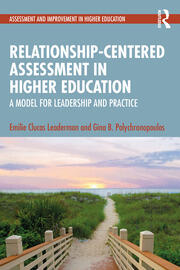
1st Edition
Relationship-Centered Assessment in Higher Education A Model for Leadership and Practice
PART I: Getting Started 1. Introduction to the RARE Model 2. Rules of Engagement: How to Use this Book PART II: RARE Model Components 3. Relate: Cultivate the Foundation for Connection 4. Affirm: Co-create the Partnership 5. Readiness: Position for Change 6. Embolden: Build Culture that Lasts PART III: Adapting and Sustaining the Work 7. Facilitate & Convene: RARE Communities 8. Conclusions and Next Steps
Biography
Emilie Clucas Leaderman is Dean of Academic Pathways and Learning Innovation at American International College and Adjunct Faculty at Woods College of Advancing Studies at Boston College, USA.
Gina B. Polychronopoulos is Department Chair and Associate Professor of Clinical Mental Health Counseling in the College of Graduate and Professional Studies at The Chicago School- Washington, D.C., USA.
“Relationship-Centered Assessment in Higher Education: A Model for Leadership and Practice makes visible the interpersonal foundations of effective assessment leadership and introduces the RARE Model as a practical guide for cultivating collaborative, trust-based partnerships with faculty and staff. Drawing on counseling-informed strategies and extensive practitioner experience, the authors offer concrete tools for navigating the human complexities of assessment work.”
Nick Curtis, Director of Assessment, University of Wisconsin, Madison, Editor-in-Chief, Research & Practice in Assessment
“Assessment is more than loops, data, reports, and dashboards; it is “people” work. The authors present a compelling argument that continuous improvement depends on cultivating a relationship-centered assessment culture. Drawing on their backgrounds in counseling, they introduce a thoughtful conceptual framework that foregrounds the central role of relationships in turning assessment into meaningful improvement.”
Gavin Henning, Professor of Higher Education, Director, Doctor of Education and Master of Higher Education Administration Programs, Director, Center for Innovation in Teaching, Learning, and Scholarship, New England College
“Relationship-Centered Assessment in Higher Education: A Model for Leadership and Practice offers both new and seasoned assessment professionals a clear, practice‑ready toolkit for doing assessment well. Through an empathic, counseling‑informed lens, Clucas Leaderman and Polychronopoulos show how supportive, appreciative assessment cultures can spark deeper inquiry into student learning and success while sustaining meaningful assessment practice. Their approach reframes assessment as a relational endeavor, demonstrating how trust, empathy, and shared purpose can transform institutional effectiveness work from a compliance task into a catalyst for learning and professional development. I recommend this book to anyone committed to building humane and enduring assessment cultures in higher education.”
Jillian Kinzie, Associate Director, National Survey of Student Engagement (NSSE), Indiana University Bloomington
