





1st Edition
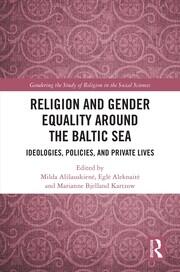
Religion and Gender Equality around the Baltic Sea Ideologies, Policies, and Private Lives
Contributors
Acknowledgements
Introduction. Milda Ališauskienė, Eglė Aleknaitė and Marianne Bjelland Kartzow
1. Religion and Gender Equality in the Baltic States: Key Aspects of Soviet and Post-Soviet Developments - Milda Ališauskienė, Dace Balode, Linards Rozentāls, Anne Kull and Artūras Tereškinas
2. Female Presidents but not Female Priests? Catholic and Evangelical Lutheran Women's Discourse on Female Ordination and Gender Relations in Estonia, Latvia, and Lithuania - Eglė Aleknaitė, Anne Kull and Ģirts Rozners
3. Conceptualizations of Gender (In)Equality among Latvian Christian Women - Aivita Putniņa
4. Between Gender Equality and Religion: Pious Baltic Muslim Women’s Quest for 'True' Islam - Morta Vidūnaitė, Anne Hege Grung and Anastasiia Babash
5. Gender as a (Non)Issue in Lithuanian Female Muslims’ Lives - Egdūnas Račius
6. Gendering Paganism in Lithuania and Estonia: Between the Reconstruction of Tradition and Memories of the Soviet Past? - Milda Ališauskienė and Liina Kilemit
7. Gender (In)Equalities in Lived Christianity: Catholic and Lutheran Evangelical Women’s Understandings of Gender Roles in the Family in Estonia and Latvia - Liina Kilemit, Aivita Putniņa, Ģirts Rozners and Olga Schihalejev
8. From the Demonization of LGBTQ+ to the Privatization of Intimate Citizenship in the Lithuanian Catholic Church - Artūras Tereškinas and Morta Vidūnaitė
9. Baltic Parable of Life and Death: Christian Opinions on Gendered Violence in the Context of the Istanbul Convention - Ilva Skulte, Gintarė Pocė and Anne Kull
10. Religious Gender Politics in Lithuania and Norway: Interdenominational and Interreligious Alliances and Their Positionings - Anne Hege Grung and Eglė Aleknaitė
11. Intersections of Religion and Gender in Public Schools of Baltic Countries - Olga Schihalejev, Laima Geikina and Rimgailė Dikšaitė
Index
Biography
Milda Ališauskienė is a professor of Sociology at Vytautas Magnus University in Kaunas, Lithuania.
Eglė Aleknaitė is a senior researcher in the Social Research Center at Vytautas Magnus University in Kaunas, Lithuania.
Marianne Bjelland Kartzow is a professor of New Testament Studies at the University of Oslo, Norway.
"The interactions between gender, in its many manifestations, culture, politics, education, individual dispositions, and the varied religions of the Baltic countries are examined and compared by scholars whose insights illuminate the vagaries of modern society far beyond the boundaries of the region. This is a volume well worth the read." - Eileen Barker, London School of Economics, UK
"Based on rich sources, this inspiring and provocative book traces the role of various spiritual traditions in both emancipation and subordination of women. It is a must-read for anyone who wants to know how religion shapes gender politics in the archetypically secular—post-Soviet and Nordic-influenced—Baltic States." - Agnieszka Kościańska, University of Warsaw, Poland
"Over the course of the book, the contributions provide fresh analysis of the contentious relationship between religion and gender equality as norms and practices in institutions and in everyday life. The overall approval of religious women in these Post-Soviet states to norms of gender equity rather than gender equality, eases conservative forces pushing anti-genderism." - Beatrice Halsaa, University of Oslo, Norway
"Religion and Gender Equality around the Baltic Sea provides a fascinating and analytically sound account of how the multiple narratives of gender equality circulate, and how they intersect with different religious narratives in religious women’s lives, religious hierarchies, and public institutions." - Alberta Giorgi, University of Bergamo, Italy
"A fascinating investigation of the intersection of power and gender in the religious communities of Lithuania, Estonia, Latvia, and Norway. In this collection of ground-breaking research by local scholars, we hear the voices of women in Baltic religious communities, ranging from the Lutheran Church to Muslim communities to neo-Pagan NRMs." - Susan Palmer, Concordia University, Canada
"This is a thought-provoking and timely exploration of how religion intersects with gender equality in post-Soviet societies. This volume combines rich theoretical insights with in-depth case studies spanning Christian, Muslim, and Pagan communities. It highlights the complexities of navigating gender roles within diverse religious traditions, offering fresh perspectives on gender justice in public and private spheres." - Jenny Berglund, Stockholm University, Sweden
