




1st Edition
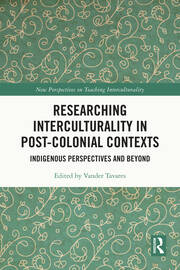
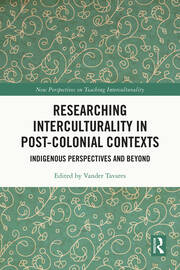
Researching Interculturality in Post-Colonial Contexts Indigenous Perspectives and Beyond
Introduction: Intercultural encounters in education in post-colonial contexts
Vander Tavares
Part I Mapping out developments of interculturality in teacher education
1 The place of interculturality in Indigenous teacher education in Brazil
Karina Flauzino and Vander Tavares
2 Science teacher training for cultural diversity: Creation and analysis of didactic strategies that foster intercultural dialogue
Francisco Velásquez-Semper, Geilsa Costa Santos Baptista, Matías Carrasco Zúñiga, Jéssica Cerqueira dos Santos, Bastián Gatica, Emanuele Maria Leite Suzart, Guilherme Nobre Monteiro dos Santos, and Luiz Gustavo Lima Cordeiro
Part II Epistemologies and experiences of Indigenous students in higher education
3 Intercultural experiences of Indigenous students at a private university in Mexico
Stefano Claudio Sartorello, Marcela Gómez Álvarez, Yasmani Santana Colin, and Casandra Guajardo Rodríguez
4 Intercultural connections and Utopian worlding: The quest for university education among the Sateré-Mawé, lower Amazon River, Brazil
Ana Letícia de Fiori
Part III Interculturality in the school context through the work of teachers
5 Socio-educational ambivalence of Indigenous knowledge: The case of teachers working in a Mapuche context
Daniel Quilaqueo Rapimán
6 Interculturality and Indigenous schools: The Xakriabá case
Verônica Mendes Pereira and Juliana Ventura de Souza Fernandes
Part IV Rethinking science, language and community through interculturality
7 Spirit languages, sacred sciences: Indigenous language commitment as a cosmopolitical interculturality
Sâmela Ramos da Silva Meirelles and Leandro Durazzo
8 “Other” education, knowledge, and sciences: Contributions from Indigenous communities of Oaxaca, in Mexico, and their vision of communality
Yolanda Jiménez Naranjo
Part V Transcultural commentaries
9 Thinking about interculturality in Latin America and Sápmi
Pigga Keskitalo
10 Interculturality, epistemological braiding, and the (im)possibility of the decolonial otherwise
Kristin Gregers Eriksen
Biography
Vander Tavares is Associate Professor at Inland Norway University of Applied Sciences, Norway. His research interests include critical second language education, teacher education, and the internationalization of higher and language education. In 2021, he was the recipient of the Equity, Diversity, and Inclusion (EDI) Award by the Canadian Bureau for International Education (CBIE) for his years-long work in support of multilingual international students in Canada. He is the editor of Social Justice, Decoloniality, and Southern Epistemologies within Language Education (Routledge, 2023) and Social Justice through Pedagogies of Multiliteracies (Routledge, 2025).
“A critical read to understand the potentialities, tensions and, political disruptions that take place when there are aspirations of intercultural projects that challenge the colonial legacies (re)produced in the own field of intercultural studies and in other educational institutions.”
Roxana Chiappa, Co-coordinator of the Nucleus of Intercultural Education, Migration and Borders: An inter-institutional effort from the South Andes Region, Universidad de Tarapacá / Rhodes University
“Researching interculturality in post-colonial contexts: Indigenous perspectives and beyond is an intellectually stimulating and much needed contribution to the field of intercultural studies. Vander Tavares understands better than anyone that conversations on interculturality cannot be separated from geopolitical and body political questions of knowledge. This timely book fills the gap in this area of research by shifting the conversation to include and engage with other ways of seeing and interpreting the world.”
Robert Aman, the author of Decolonising Intercultural Education: Colonial Difference, the Geopolitics of Knowledge, and Inter-Epistemic Dialogue (Routledge)
