





1st Edition
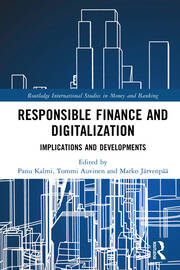
Responsible Finance and Digitalization Implications and Developments
- Introduction
Panu Kalmi, Tommi Auvinen and Marko Järvenpää - Conventional or Alternative? How to Assess the Alternativeness of a Bank
Silvio Goglio and Ivana Catturani: - Trends in Executive Compensation Across Bank Types
Shaker Ahmed, Denis Davydov and Sami Vähämaa - Risk Spillover Between Islamic and Conventional Banking Sectors
Anupam Dutta, Jussi Nikkinen and Timo Rothovius - From Vernacular Accounting to Standardized PMS: Logic Multiplicity in a Cooperative Bank
Anniina Kinnunen, Marko Järvenpää and Antti Rautiainen - Efficiency vs. Values: Institutional Logics, Situated Rationality and Performance Measurement in a Cooperative Bank
Marko Järvenpää, Henri Teittinen, Pasi Sajasalo, Tommi Auvinen, Teppo Sintonen and Tuomo Takala - Digitalization Transformation in Banking: Customer Preferences, Bank Attitudes and Performance
Ewa Miklaszewska, Krzysztof Kil and Marcin Idzik - Data Balance Sheet in OP Financial Group
Mika Ylinen, Antti Myllymäki and Marko Järvenpää - Factors Inhibiting the Adoption Intention of Digital Payment Platform
Aijaz A. Shaikh, Francisco J. Liebana Cabanillas and Richard Glavee-Geo - Has Crowdfunding’s Potential Been Unleashed in the Baltics?
Valdone Darskuviene, Julija Kirsiene, Jurgite Malinauskaite and Ausrine Pasvenskiene - Investor Protection Strategies in Crowdfunding Regulation: The 4i’s Model
Marika Salo-Lahti and Vesa Annola - Regulation and Development of Private Equity in Europe
Matti Turtiainen, Jani Saastamoinen and Niko Suhonen - Financial Institution’s Reporting Requirements and the Criteria for a Good Tax System
Erkki Kontkanen and Juha Lindgren - Sustainable and Responsible Investment Funds and Sustainable Transition
Giovanni Ferri and Mariantoinetta Intonti - Banks and Credit Unions as Providers of Financial Literacy: A Complex Relationship
Panu Kalmi and Olli-Pekka Ruuskanen - Organizational Identity Construction as a Control Mechanism
Teppo Sintonen, Tuomo Takala, Pasi Sajasalo, Tommi Auvinen and Marko Järvenpää
Topic I: Organizational structures and mission in banking
Topic II: Digitalization shaping organizational and market boundaries
Topic III: Regulation in changing financial sector landscape
Topic IV: Social responsibility in the financial sector
Biography
Panu Kalmi (PhD) is a professor of economics at the University of Vaasa, Finland. His main research and teaching interests relate to financial literacy, economic education and banking. He is especially interested in the use of games and other active learning methods in economic education and works with schools to further financial literacy among the youth.
Tommi Auvinen (PhD) is a senior lecturer and leading researcher in Management and Leadership at the Jyväskylä University, School of Business and Economics (JSBE), Finland, and a docent in narrative leadership research at the University of Lapland. His research focuses on leadership themes, including storytelling and discursive power and strategy-as-practice.
Marko Järvenpää (PhD) is a professor of accounting at the University of Vaasa, School of Accounting and Finance, Finland. He studies management accounting with qualitative methods. His research focuses on roles of management accountants, management accounting change, performance measurement, sustainability, public sector, data analytics and theoretically on institutional and stakeholder theories.
"Now that the various forms of Decentralized Finance (DeFi) solutions will be among the most relevant next generation forces in the development of financial intermediation practices, it is of extreme importance to understand the premises of the next steps in this process. Responsible Finance and Digitalization: Implications and Developments gives a coherent and broad-based view on the recent evolution of the financial sector in this respect. It describes how the current market players are adapting to the institutional changes and to the challenge coming from new actors and competitors. It also considers thoroughly the ability of present financial organizations to provide fixes to the challenges at the systemic level and how a healthier, more diverse, and socially responsible financial sector is beneficial to the operations of the market economy as a whole. This book is a must-read reference for scholars and students interested in the characteristics of financial intermediation in the future, especially due to its exceptional coverage of the roles of organizational structures, digitalization, regulation and social responsibility of financial institutions. In many respects, it is relevant to anyone interested in the most recent steps that have led us to the doorsteps of the potential wider out-break of DeFi solutions, too."
—Professor Juha Junttila, University of Jyväskylä, Finland
