





1st Edition
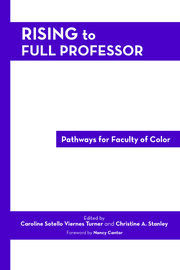
Rising to Full Professor Pathways for Faculty of Color
Foreword
Nancy Cantor
Preface
Acknowledgments
Introduction
Part One. Key Themes
1. Key Themes Emerging From the Literature
Caroline Sotello Viernes Turner, Christine A. Stanley, and Amy M. Leung
Missing Full Professors. Demographic Data
Scarcity of Research
Quantitative Research
Unclear Expectations in Application and Criteria for Promotion
Defining Meritocracy
Service and Teaching
The Pipeline Myth
Part Two. The Editors’ Pathways
2. My Journey from Migrant Field Labor to Full Professor. How I Interpreted the Phrase, ‘Bloom Where You Are Planted’
Caroline Sotello Viernes Turner
3. "Listen to Your Heart". A Jamaican American’s Journey of Accepting the Challenges of Navigating the Professoriate to Full Professor
Christine A. Stanley
Part Three. Pathway Experiences From the Contributing Scholars
4. Maneuvering Through the Maze. Pursuing Promotion to Full Professor
William B. Harvey
5. Through the Eye of the Needle
Anne-Marie Nuñez
6. Happy Accidents. Considering Career Pathways and Institutional Practices for Enhancing Faculty Promotion
Mitchell James Chang
7. On Becoming a Full Professor. Reflecting on My Journey from Indian Town Road to the Academy
Susan C. Faircloth (Coharie)
8. Making a Way Out of No Way. One Woman’s Journey in Academic Engineering
Gilda A. Barabino
9. The Whole Professor
Lorenzo M. Smith
10. Rushing
D-L Stewart
11. "My Color is White"
Gabriela C. Weaver
12. Pathways to Promotion. Obstacles and Opportunities for Women of Color in Academia
Adia Harvey Wingfield
13. Be Still, Eat Some Chocolate, and Let God
Halaevalu F. Ofahengaue Vakalahi
14. The Unintentional Professor and Endowed Chair
Suzanne SooHoo
15. Trajectory Toward Full, Some Humble Advice
Lisa Magaña
16. The Journey to Less than 1%. African American Full Professors in Computer Science
Juan E. Gilbert
17. Framing the Stories of Place and People. A Genealogical Tree of Two Mexican-American Brothers Becoming Professors
Francisco Guajardo, Miguel A. Guajardo
Part Four. Summary, Key Recommendations, and Conclusion
18. Summary, Key Recommendations, and Conclusion
About the Editors
Index
Biography
Caroline Sotello Viernes Turner is professor emerita for the doctorate in educational leadership program at California State University, Sacramento (CSUS), and Lincoln professor emerita of Higher Education and Ethics at Arizona State University (ASU). At CSUS, Turner served as interim dean for the College of Education. Prior to her appointment at ASU, she was Professor of Educational Policy & Administration at the University of Minnesota, Twin Cities where she co-founded the national Keeping our Faculties of Color Symposium. She is also past president of the Association for the Study of Higher Education (ASHE). Her research and teaching interests include faculty gender and racial/ethnic diversity, leadership and organizational change, and the use of qualitative methods for policy research. Her publications, particularly Faculty of Color in Academe: Bittersweet Success (with Myers, Jr.), Diversifying the Faculty: A Guidebook for Search Committees, and Women of Color in Academe: Living with Multiple Marginality advanced the dialogue on faculty gender and racial/ethnic diversity among scholars and practitioners. Dr. Turner has served on the editorial boards of the Journal of Higher Education, The Review of Higher Education, and the Journal of Hispanic Higher Education. She is one of the founding editorial advisory board members for the Journal of Diversity in Higher Education and the Journal of Minority Achievement, Creativity, and Leadership. Her numerous recognitions include the University of California, Davis (UCD) School of Education Distinguished Alumna Award, Sacramento State’s University-Wide Faculty Award for Research and Creative Activity, the Association for the Study of Higher Education (ASHE) Council on Ethnic Participation Mildred Garcia Senior Scholar Award, and the American Educational Research Association (AERA) Scholars of Color in Education Career Contribution Award. Dr. Turner currently serves on the UCD School of Education Dean’s Board of Advisors and was honored to present their 2018 graduation keynote address. (See: https://video.ucdavis.edu/media/2018+School+of+Education+Keynote+-+Carolyn+Turner+-+June+13%2C+2018/.... Turner received her undergraduate degree in History and her master’s degree in Educational Psychology from the University of California, Davis. She received her Ph.D. in Administration and Policy Analysis from the Stanford University School of Education.
Christine A. Stanley is a Regents professor, professor of higher education, holder of the Ruth Harrington Endowed Chair for Educational Leadership, and vice president and associate provost for diversity emerita in the School of Education and Human Development at Texas A&M University. [She has served the university as vice president and associate provost for diversity, acting vice provost for academic affairs, interim associate provost for undergraduate studies, executive associate dean for faculty affairs in the College of Education and Human Development, and associate dean of faculties. She provided leadership for the TAMU National Science Foundation (NSF) ADVANCE Scholar Program and served on the presidential task force to develop and write the first Standards of Professional Practice for Chief Diversity Officers, commissioned by the National Association of Diversity Officers in Higher Education (NADOHE). A past president of the Professional and Organizational Development (POD) Network in Higher Education, she is a recipient of numerous university and national awards including the Outstanding Staff Award from The Ohio State University, TAMU Women’s Faculty Network (WFN) Award for Mentoring, the TAMU Association of Former Students (AFS) Distinguished Achievement Award for Graduate Mentoring, the Outstanding New Faculty Award from the College of Education Development Council, the Mildred Garcia Award for Exemplary Scholarship for a Senior-Practitioner Scholar from the Association for the Study of Higher Education (ASHE), and two awards from the Professional and Organizational Development Network in Higher Education–the Robert Pierleoni Spirit of POD Award for leadership efforts in diversity and, the named Christine A. Stanley Award for Diversity and Inclusion Research in Educational Development.She teaches administration of higher education, college teaching, diversity and social justice in higher education, and professional development in higher education. Dr. Stanley has a passion for how colleges and universities function as organizational systems. Institutional climate for teaching and learning and the climate for minoritized faculty and students remain salient as research goals. She developed these interests in graduate school at Texas A&M from her experiences as a Black woman from Jamaica, and with the support of mentors who encouraged and supported her to find answers to the systemic social and cultural disparities in higher education institutions. In March 2019, she received the Frank W. Hale Distinguished Service Award for her leadership efforts in diversity from the National Association of Diversity Officers in Higher Education and, in 2021 the Mentoring Award from the Association for the Study of Higher Education (ASHE). Dr. Stanley has edited several books and peer-reviewed publications, including, Faculty of Color: Teaching in Predominantly White Colleges and Universities. Her research focuses on faculty professional development, administrator development, and the experiences of minoritized faculty in predominantly White colleges and universities. Her current research activities include working with colleagues in the College of Engineering, along with system institutions Prairie View A&M University, Texas A&M Corpus Christi, and Texas A&M International to study the effects of undergraduate research mentoring on the persistence and retention of African American and Hispanic students in engineering through the Louis Stokes Alliance for Minority Participation Program (LSAMP). She has consulted on faculty development and diversity issues in the United States, Armenia, Canada, China, Mexico, and South Africa. Dr. Stanley is a native of Jamaica, The West Indies and holds a B.Sc. Degree in Biology (cum laude) from Prairie View A&M University, a M.Sc. Degree in Zoology from Texas A&M University, and a Ph.D. in Curriculum & Instruction from Texas A&M University.
"To improve the position of faculty of color we have to understand the challenges and lives of faculty of color. Rising to Full Professor accomplishes a great deal. Baseline data explains the under-representation of faculty of color. The challenges faculty of color face by way of obscure tenure and promotion policies highlights the hurdles individuals face. As importantly, Rising to Full Professor puts a face on the challenges. We learn not only about composite data, but also the individual hurdles that faculty of color face.
Thoughtful. Nuanced. Interesting. A good read on an important topic."
"Bravo! This pathbreaking book edited by two Higher Education leaders offers an impressive array of brilliant academics of color recounting experience with becoming full professors in our systemically racist society. With a critical eye on how they advanced academically, they detail often herculean efforts to counter racial barriers to promotion while simultaneously providing savvy mentoring advice and recommendations for more junior colleagues of color."
Joe Feagin, Distinguished University Professor, Texas A&M University; Past-President, American Sociological Association; and senior co-author of Racist America
"Newly tenured associate professors often ask, ‘Now what? How I do I achieve promotion to full professor?’ This pathway is elusive, especially for faculty of color who remain woefully underrepresented as full professors. Rising to Full Professor is a long overdue contribution centering diverse pathways and naming challenges along the journey. This is a must-read for scholars of color aspiring to full professor and affirmation we are more than worthy of the achievement despite obstacles."
Lori Patton Davis, Chair, Department of Educational Studies, and Professor of Higher Education and Student Affairs, Ohio State University
"Numbers matter. Lived experiences matter. Institutional practices matter. And when they tell the same story, as they do in this compelling analysis of the norms and practices of daily life in academe that conspire to land us with such scarcity of senior faculty of color, we need to all pay close attention. As the editors of this powerful volume conclude: ‘Isn’t it time for institutions to live up to their espoused rhetoric of diversity and inclusive excellence and rethink how we recruit, evaluate, and reward faculty work…?’ Clearly, the answer to that question is a resounding yes. The testimonials here of those who successfully travelled the wickedly biased pathway to senior status underline its urgency – this is the time for change, and there is enormous collective wisdom here for faculty of color, faculty allies, and administrators alike about how to act affirmatively to rewrite the story going forward.
As this volume so fulsomely teaches us, we too can learn how to transform our institutions and grab the opportunity for diverse excellence at hand, if we listen to the words of these teachers – these survivors who are stars – who remind us that numbers matter and lived experiences matter and the more our institutions open ourselves to embrace them as the leaders for change, the better off we all will be."
Nancy Cantor, Chancellor of Rutgers University–Newark
