




1st Edition
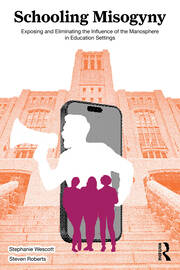
Schooling Misogyny Exposing and Eliminating the Influence of the Manosphere in Education Settings
Part I: Increasing levels of misogyny and sexism in Australian schools
Chapter 1: Misogyny and institutional misogyny in schools
Chapter 2: The convergence of corrosive conditions that re-animate misogyny
Chapter 3: The ‘manfluencers’ come to school
Chapter 4: Examining the school as institution: The practice of institutional gaslighting
Part II: Prevention work in schools: School-based approaches to responding to misogyny and manosphere-aggravated harms
Chapter 5: Education as primary prevention work: Implementing Respectful Relationships Education
Chapter 6: Pedagogical approaches for violence prevention
Chapter 7: For the eradication of gendered harms in schools and education settings
Biography
Stephanie Wescott, PhD, is Lecturer in Humanities and Social Sciences, Faculty of Education, Monash University, Australia. Her research examines misogyny and gender-based violence in school settings.
Steven Roberts is Professor of Sociology in the School of Social Sciences, Faculty of Arts, Monash University, Australia. He has published widely in the area of critical masculinities studies, including on risky drinking, sexting, the manosphere, computer gaming, emotionality, violence, domestic labour and paid care work.
'A rare mix of prescient analysis, unflinching challenge, and practical solutions, Schooling Misogyny shows how schooling is an enabling environment for pervasive and rising misogyny and is simultaneously the best hope we have to confront it. Urgent, powerful, and an essential call to action: this is the book every educator needs right now.'
Professor Cynthia Miller-Idriss, School of Public Affairs and School of Education, American University, USA
‘Few academic texts manage the balance between readability, robust research and real-world remedies with the deftness of Schooling Misogyny. This book will be an essential tool for all educators hoping to tackle the dangers of structural misogyny in schools. Ultimately, Schooling Misogyny’s greatest benefits will be for all the students who depend on their schools to keep them safe, help them learn, and teach them how to build a better world for everyone.’
Jane Gilmore, award winning author of best selling books Fixed It: Violence and the representation of women in the media, and It takes a village to teach your children about consent
‘This excellent and urgently needed book addresses the growing influence of online male supremacism in schools today. Crucially, it avoids positing the manosphere as a problem that can be rooted out of an otherwise functional education system. On the contrary, it situates the impact of and responses to digital misogyny as continuous with a long and deep-rooted history of institutional misogyny in schools, demonstrating why and how successfully tackling this issue requires self-critique, honesty and long-term, whole-school approaches. Schooling Misogyny’s key message, that ‘unlearning misogyny’ benefits everyone in education, is a powerful call to action, and will resonate far beyond the Australian context.’
Professor Debbie Ging, Institute for Research on Genders and Sexualities, Dublin City University, Ireland
'Amid growing concern about the influence of the manosphere in education settings, Schooling Misogyny is a timely contribution. Empirically grounded and practically focused, the book offers compelling accounts of the persistence and escalation of sexism and misogyny in Australian classrooms. It builds on this evidence to provide guidance for schools and policymakers seeking to foster more gender-respectful schooling environments. It is an important read for educators, leaders, and policymakers committed to preventing gender-based violence through education.'
Professor Amanda Keddie, School of Education, Deakin University, Australia
