




1st Edition
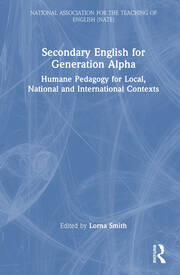
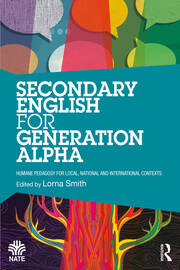
Secondary English for Generation Alpha Humane Pedagogy for Local, National and International Contexts
Epigraph: In all its forms
Victoria Ekpo
Introduction
Lorna Smith
Section 1: Speaking and Listening
1: Dialogue in the English classroom
Ruth Aman
2: Linguistic Justice efforts in England’s schools
Ian Cushing
Section 2: Interpreting Literature
3: How do students read and interpret whole texts and become engaged readers?
Julia Sutherland & Jo Westbrook
4: Making meaning together: how can literary theory develop critical reading skills in English?
Joe Barber
5: Drama-based pedagogy and reading in the secondary English classroom
Sue Pinnick
6: Poetry in the Moment
Julie Blake
Section 3: Exploring Non-Fiction
7: Literary non-fiction in a post-truth era curriculum
John Perry
8: From the perspective of trees: developing students eco and socio-critical literacies with non-fiction texts
Terra Glowach & Kalpa Ghelani
Section 4: Fostering Writing
9: Hands on: Using a ‘PlayBox’ to support teachers develop racial literacy through workshops and personal writing
Lorna Smith
10: Four ways personal language autobiographies can transform the English teaching of Generation Alpha
Francis Gilbert
11: ‘Made in Stoke-on-Trent’. From Potters to ‘Best China’ Poets: Creating a collaborative poetry anthology
Rebecca Sherratt
12. Metalinguistic knowledge and writing development.
Annabel Watson
Biography
Dr Lorna Smith is Associate Professor of Education at the University of Bristol.
I can’t imagine a more important time for this book to be read and understood. In bringing together these examples of creative and enlightened practice, it conceives a vision of English teaching that’s coherent, ambitious and supported by research – but most of all, humane.
The essays are rooted in strong classroom practice, much of which has been muffled or even silenced by educational ideologues over the last decade or so. Classroom teachers will find this book by turns useful, invigorating and inspirational.- Anthony Cockerill, Director, National Association for the Teaching of English.
Secondary English for Generation Alpha is a timely response to the conditions and issues shaping experiences of young people today, in school, in society and online. Through accounts of several localised examples of English education, it explores what the subject of English is for as we begin the second quarter of the twenty-first century, in an era when many of our assumptions about English in the liberal arts tradition have been severely tested. The innovations of teachers and teacher educators described in this book make clear that liberal arts English purposed to social justice survives and thrives across the UK, in forms of English which respond to and champion local knowledge, communities and identities. Throughout, Secondary English for Generation Alpha interrogates the frameworks in which English educators work, addressing the breadth of the subject (reading, writing, oracy, media and digital literacies), always focussed on nuanced expert pedagogies offering rich learning experiences for students. This is English for now, influencing the young people who will shape our mid-century.
- John Gordon, Professor of Language Arts and Learning, University of East Anglia
If English teachers are empowered to take the pedagogies detailed in this book into their classrooms, then there’s hope for Generation Alpha. Because reading each chapter about a different aspect of English teaching, it’s clear that the insightfully explored approaches are not only humane, but also ambitious, academically rigorous and evidence-informed. They are what every student of English needs and deserves. In drawing of the rich heritage of the subject, along with recent research projects, to inform present and future possibilities, this book is much more than a guide to teaching - it is also an impassioned call-to-action. Too many students in recent years have missed out on what the subject has to offer. Too many teachers have had to teach in ways that run counter to their professional expertise. No more! Policymakers take note – the wisdom held within these pages is key to helping secondary English get its mojo back!
- Andrew McCallum, Director, English and Media Centre
In recent years, school English has been flattened out, subject to a series of centralising pressures and policies, with curriculum-making happening at a great remove from the classroom. The essays in this collection speak to English teachers precisely because of their emphasis on the local and the particular, and on the agency of teachers and students alike. The contributors plough widely different furrows within the broad field of English studies; what unites these essays, though, is their rootedness in practice – in accounts of work done currently or recently in and around real classrooms. The cumulative effect of the collection is to uncover – and celebrate – pedagogies of possibility.
- John Yandell, Professor of English in Education, UCL, London
In the light of the National Literacy Trust’s 2024 report on the decline in the number of young people who read for pleasure, crucial for cognitive development, as well as the opportunities that are expected to open up for those skilled in the use of language and critical thinking in the age of AI, then this intervention could not be more timely. The essays in this volume, written by respected experts in the field on a wide range of topics – from oracy to collaborative making – will help us rebuild the creative foundations of the study of English Language and Literature in schools. This is a volume that all teachers, in secondary, further, and higher education, will want to read and use.
- Jennifer Richards, English (2001) Professor, University of Cambridge, FBA, FEA, Chair of the English Association.
