



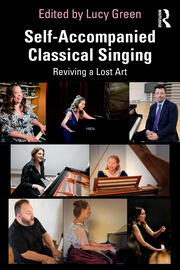
1st Edition
Self-Accompanied Classical Singing Reviving a Lost Art
Acknowledgements
Biographies of the authors
Preface
Chap 1: Lucy Green – Why does classical self-accompaniment matter?
SECTION 1: SELF-ACCOMPANIED CLASSICAL SINGING FROM THE 13TH TO THE 21ST CENTURIES
Lucy Green – Introduction and overview
Chap 2: Beth Garfinkle – Self-accompanied singing from the 12th to the 16th century: the troubadours to the concerti delle donne
Chap 3: Robin Bier – Self-accompanied singing, vocal pedagogy, and practice in the 17th and 18th centuries
Chap 4: Hermione Ruck Keene – Self-accompaniment by women in the 19th century: negotiating the private and the public spheres
Chap 5: Robin Bier – The decline of professional self-accompaniment in the 20th century
Chap 6: Elizabeth Pearse – The re-emergence of self-accompaniment in contemporary classical music
SECTION 2: THE REVIVAL OF SELF-ACCOMPANIMENT IN CLASSICAL SINGING TODAY?
Lucy Green – Introduction and overview
Chap 7: David Baker and Lucy Green – Quantitative survey results: Practices and attitudes amongst today’s classical singers concerning self-accompaniment
Chap 8: Michael Bonshor and Lucy Green – Qualitative survey results: Divided views about self-accompaniment amongst classical singers today
Chap 9: Janet Oates – Phenomenological perspectives from novice singer-pianists
Chap 10: Lucy Green – The practices of experienced singer-pianists: How does professional self-accompaniment begin, and how can it lead to public performance?
Chap 11: Lucy Green – The values of experienced singer-pianists: challenge, fulfilment, feedback, and education
SECTION 3: WHAT COULD COME NEXT?
Lucy Green – Introduction and overview
Chap 12: Lucy Green – The potential of self-accompaniment for future research, performance practice and education
APPENDICES AND INTERNET LINKS
Appendix A: Some current-day and historical classical self-accompanists
Ai) Early music current-day self-accompanists who sing with plucked or bowed strings (generally performing music up to ca. 1750)
Aii) Classical current-day self-accompanists who sing with keyboard and bowed strings (generally performing music since ca. 1750)
Aiii) Conductors who sing and conduct at the same time
Aiv) Self-accompanied songs posted on YouTube by international opera singers during the Covid lockdowns of 2020 to 2022
Av) Historical film of self-accompanied performances by singer-pianists
Appendix B: Chapter 9 research participants’ backgrounds and some final performances by novice singer-pianists
Appendix C: Chapters 10 and 11 research participants’ biographies
Biography
Lucy Green is Emerita Professor of Music Education at the UCL Institute of Education, London UK. She is internationally known for her work in music education, particularly in relation to gender, popular music, informal learning, new pedagogies, ideology, musical meaning, inclusion and, more generally, the sociology of music.
