





1st Edition
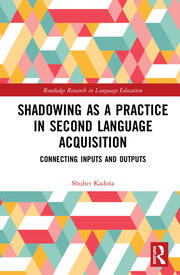
Shadowing as a Practice in Second Language Acquisition Connecting Inputs and Outputs
By Shuhei Kadota
Copyright 2019
214 Pages
139 B/W Illustrations
by
Routledge
214 Pages
139 B/W Illustrations
by
Routledge
214 Pages
139 B/W Illustrations
by
Routledge
Also available as eBook on:
Shadowing is a theoretically and empirically well-examined method to develop L2 learners’ listening comprehension (input effect); enhance their subvocal rehearsal mechanism in the phonological working memory for learning new words, formula, and constructions (practice effect); simulate some stages of speech production (output effect); and develop metacognitive monitoring and control by... Read more
1. What is Shadowing?
2. Shadowing for L2 Listening Comprehension
3. Shadowing for Promoting Second Language Learnability
4. Shadowing for L2 Speech Production
5. Shadowing to Develop Metacognitive Monitoring and Control
6. Establishing a New Concept of Practice in L2 Acquisition
Biography
Shuhei Kadota is a Professor of Applied Linguistics, Graduate School of Language, Communication and Culture, Department of Law at Kwansei Gakuin University, Japan.
