




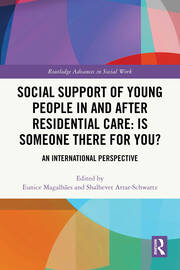
1st Edition
Social Support of Young People in and after Residential Care: Is Someone There for You? An International Perspective
Introduction
Eunice Magalhães and Shalhevet Attar-Schwartz
Part One – Conceptual and Theoretical Framework
Chapter One - Social Support and Social Networks of Young People in Residential Care and Post-Care: Conceptual Frameworks and Theoretical Insights
Shalhevet Attar-Schwartz, Eran Melkman and Eunice Magalhães
Chapter Two - Transformative Change for Children in Residential Care: Exploring the Potential of Support for Work, Recreation and Educational Opportunities from a Life Course Perspective
Robbie Gilligan
Part Two – Social Support While in Residential Care
Chapter Three – Social Support and Psychological Functioning: A Review of Empirical Evidence in the Portuguese Context
Eunice Magalhães and Maria Manuela Calheiros
Chapter Four – Social Support from Nuclear and Extended Family, Peers, and Staff of Youth in Residential Care: Evidence from Israel
Shalhevet Attar-Schwartz, Shulamit Pinchover, Adena Hoffnung-Assouline, Adi Fridman-Teutsch, Netanel Shalem, Yisca Huri and Emmanuel Grupper
Chapter Five – “Somewhere You Can Grow” – Young People and Workers’ Views on Residential Care Settings and the Value of Relationships and Social Support
Tim Moore, Anne Graham and Antonia Canosa
Chapter Six – Perceived Social Support in Residential Care: Its Contribution to Adolescents’ Mental Health and Quality of Life
Marianne Tevik Singstad
Chapter Seven – Social support and well-being among Canadian young people in family foster care, kinship care, or group care
Elena Gallitto and Robert J. Flynn
Part Three - Care Leavers and Transition from Residential Care
Chapter Eight – Trends in Social Support During the Transition to Adulthood for Youths who Spent Time in Congregate Care in California
Keunhye Park, Nathanael J. Okpych, and Mark E. Courtney
Chapter Nine – Formal and Informal Social Networks of Israeli Care Leavers during the Transition to Adulthood
Yafit Sulimani-Aidan
Chapter Ten – Social Support for Residential Care Leavers in Ghana:
The Perspectives and Experiences of Social Workers and Residential Care Youth Workers
Kwabena Frimpong-Manso
Chapter Eleven – Is Someone There for Them?: Care Leavers’ Experiences, Challenges, and Support During and After Residential Care
Kiran Modi, Gurneet Kaur Kalra, and Leena Prasad
Part Four – Young People In and After Residential Care Through an Intersectional Lens
Chapter Twelve – LGBTQIA+ young people leaving care: Exploring social challenges and social support in three countries
Mónica López López, Mijntje ten Brummelaar, Gerald P. Mallon and June C. Paul
Chapter Thirteen – Is Anyone There? Supports Available for Unaccompanied Migrant and Non-Migrant Residential Care Leavers in Spain
Federica Gullo, Laura García-Alba, Iriana Santos, and Jorge F. del Valle
Part Five – Interventions and Services for Fostering Social Support
Chapter Fourteen – Social support of young people during and after residential youth care in the Netherlands: The role of the family, care workers, and residential group
Erik J. Knorth, Annemiek T. Harder, and Jonathan D. Leipoldt
Chapter Fifteen – Caring for the Caregivers: Evaluating Brazil’s “Cuida” Program Aiming at Promoting Skills for Building Caring Relationships with Children and Youth
Bruna Wendt and Débora Dalbosco Dell'Aglio
Conclusion
Shalhevet Attar-Schwartz and Eunice Magalhães
Biography
Eunice Magalhães (Ph.D.) is a researcher at CIS-ISCTE and has been teaching topics related to related to child maltreatment, child protection, foster care, and residential care at ISCTE for the past years. Her research also focuses on the mental health and resilience of vulnerable groups.
Shalhevet Attar-Schwartz (Ph.D.) is a full professor at the School of Social Work and Social Welfare at the Hebrew University of Jerusalem. Her research focuses on child well-being and child welfare, with a particular emphasis on children and youth in out-of-home care, including residential care settings, family foster care, and adoption.
