




1st Edition
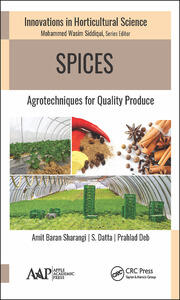
Spices Agrotechniques for Quality Produce
Spice Crops: Scenario and Significance. Spice Crops: Classification. Agrotechniques of Different Spices. Recent Approaches on Improved Production Technology of Spices Around the World. Promises of Organic Spices. Future Thrust Areas.
Biography
Amit Baran Sharangi, PhD, is a Professor of Horticultural Science and is presently acting as the Head of the Department of Spices and Plantation Crops in the Faculty of Horticulture at Bidhan Chandra Krishi Viswavidyalaya (Agricultural University), India. He has published many research papers in peer-reviewed journals, as well as conference papers, book chapters, and popular scientific articles.
Suchand Datta, PhD, is currently an Associate Professor in vegetable and spice crops at Uttar Banga Krishi Viswavidyalaya, Pundibari, Cooch Behar, West Bengal, India. He has published many research papers in national and international journals, several popular articles, along with several books and book chapters. He has received several awards for his work.
Prahlad Deb, PhD, is currently Assistant Professor of Horticulture at the Institute of Agriculture (Palli Siksha Bhavana), Visva-Bharati, Sriniketan, West Bengal, India. Dr. Deb has been teaching courses related to horticulture for several years. His major thrust of research is in minor horticultural crops, postharvest technology, and value-addition of horticultural crops. He is working on two major research projects funded by the Department of Atomic Energy (BRNS-BARC) and National Horticulture Mission, India.
"This book precisely highlights several important spices with their systematic position, national and international status, diverse uses, proximate composition, bioactive principles, agro-techniques for quality production, and value addition in a comprehensive and readable form. The efforts made by the authors are commendable and, I am sure, will be helpful for students, researchers, and industrialists to gain and improve their knowledge in this direction and ultimately provide a new treat for the livelihood of millions of farmers reeling under social and economic stresses. . . . A tremendous effort."
—From the Foreword by C. Chattopadhyay, PhD, Vice Chancellor, Uttar Banga Krishi Viswavidyalya, India
"This book is very well thought through, well written, and easy to read. The book is comprehensive and packs a lot of information on production statistics, production techniques, uses, and value, adding of a wide range of spice crops in India in world context. The book reflects in-depth information based on published literature and personal research experience combined to provide the reader with profound knowledge of practical use. This book could be a good textbook at the undergraduate level. The authors have done painstaking research and provided scientific, factual information. The book will be useful to producers, connoisseurs of spices, students, and academic professionals."
—Dr. Srinivasa Rao Mentreddy, Professor, Crop Science, Department of Biological and Environmental Sciences, Alabama A&M University
