




1st Edition
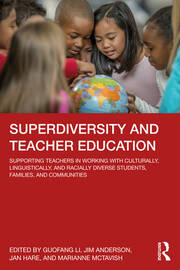
Superdiversity and Teacher Education Supporting Teachers in Working with Culturally, Linguistically, and Racially Diverse Students, Families, and Communities
Foreword
Stephen May
Introduction: Superdiversity, Emergent Priorities, and Teacher Learning
Guofang Li, Lilach Marom, Jim Anderson, Jan Hare, and Marianne McTavish
Part 1: Contexts of Teacher Education in a Superdiverse World
1. Teaching Superdiverse Students in a Transnational World: Rethinking Teacher Education
Guofang Li
2. Trickster Comes to Teacher Education
Jan Hare
3. Getting Past the White Paper: Inclusion, Antiracism and Decolonial Inheriting in Teacher Education
Lisa K. Taylor
4. Important and Unnecessary: The Paradox of White Preservice Teacher Perceptions of Culturally Relevant Pedagogy
Jacob S. Bennett
5. Contexts and Complexity: Promoting Racial and Linguistic Justice Through Bilingual Dual Language Teacher Education
Manka Varghese, Teddi Beam-Conroy, Renee Shank, and Rachel Snyder
Part 2: Research on Teacher Education in a Time of Superdiversity
6. Teacher Education for Diversity Through an Autoethnographic Lens
Antoinette Gagné
7. Pre-Service Teachers’ Critical Dispositions Towards Language: Transforming Taken-for-Granted Assumptions About Racially, Culturally, and Linguistically Diverse Learners Through Teacher Education
Andrea Sterzuk
8. Prism of Promise: Towards Responsive Tools for Diverse Classrooms
Patriann Smith and Sara Hajek
9. Connecting Educators, Families and Communities Through PASTEL (Plurilingualism, Art, Science, Technology and Literacies) Approaches in and Around French Immersion
Danièle Moore
10. Infusing ELL Preparation into Initial Teacher Preparation: (How) Does It Work?
Ester de Jong
Part 3: Engaging Practices for Educators for Superdiversity
11. Academic Support for Refugee Students in Elementary and Secondary Schools and Teachers’ Quandaries About Inclusivity
Hua Que and Xuemei Li
12. Partnering with African American Parents in the United States: Implications for Educators
Patricia A. Edwards and Kristen L. White
13. Some Lessons Learned from Working with Children and Families in Diverse Communities: Looking Back, Looking Forward
Jim Anderson and Ann Anderson
14. Assessment Practices in the Diverse Class Setting: A Fine Balance
Hetty Roessingh
15. Diversity as the Norm: Teaching to and Through Superdiversity in Post-Secondary Indigenous Education Courses
Nikki L. Yee and Sara Florence Davidson
Conclusion: Teaching and Teacher Education in an Era of Superdiversity: Challenges and Opportunities
Lilach Marom, Caroline Locher-Lo, April Martin-Ko, Monica Shank, Zhuo Sun, and Kwesi Yaro
Biography
Guofang Li is Professor and Canada Research Chair (Tier 1) in Transnational/ Global Perspectives of Language and Literacy Education of Children and Youth at the University of British Columbia, Canada.
Jim Anderson is Professor of Literacy at the University of British Columbia, Canada.
Jan Hare is Associate Dean of Indigenous Education and Canada Research Chair (Tier 1) of Indigenous Pedagogy at the University of British Columbia, Canada.
Marianne McTavish is Professor and Associate Dean of Teacher Education at the University of British Columbia, Canada.
"The four editors (Li, Anderson, Hare, and McTavish) bring a wealth of knowledge from various intersecting fields, including transnational language, literacy, indigenous education, and teacher education…Even the editorial board represents superdiversity in their professional approaches…Anyone already engaged in work described as culturally relevant, culturally sustaining, critical race, abolitionist, or intersectional (for example) will find agreement and support from these chapters."
-- Teachers College Record, August 30, 2021
