



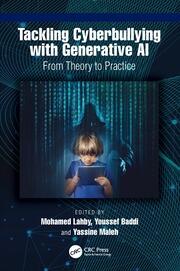
1st Edition
Tackling Cyberbullying with Generative AI From Theory to Practice
Part I. Cyberbullying in the Age of GenAI: State-of-the-Art
Chapter 1
Large Language Model–Driven Frameworks for Intelligent Cyberbullying Detection and Prevention
Balajee Maram
Chapter 2
Generative Artificial Intelligence as a Digital Social Mediator: Bridging Cyberbullying Detection and Empathic Intervention
Said Benlakhda, Mohammed Rziza, and Rachid Oulad Haj Thami
Part II. Large Language Models (LLMS) for Cyberbullying Detection
Chapter 3
LLM-Based Techniques for Detecting Cyberbullying
Fawaz A. Khasawneh, and Qasem Abu Al-Haija
Chapter 4
Leveraging GPT, BERT, and Transformer Models for Identifying Cyberbullying.
Shahed AlTamimi, and Qasem Abu Al-Haija,
Chapter 5
Modeling Subjective Disagreement in Irony Detection
Ibtissam Touahri
Chapter 6
Small Language Models for Cyberbully Identification from Social Media Texts in Bangla Language
Mahin Montasir Afif, Hasin Almas Sifat, Md. Mortuza Ahmmed, Md. Ashraful Babu, and Mohamed Lahby,
Part III. Case Studies and Practical Solutions
Explainable Generative AI for Cyberbullying Detection: Models, Metrics, and Case Studies
Sathiskumar Meganathan
Chapter 8
Cyberbullying Detection and GenAI-Assisted Intervention in Darija: A Hybrid Approach
Abdelkarim Tahiri, Boubker Sbihi, Rachid Gouarti, Fatima Mourchid, and Ali El Ksimi,
Chapter 9
Voices Under Fire: Cyberbullying of Brand Advocates in Digital Communities
Wolfgang J. Weitzl
Part IV. Ethical Challenges and Future Trends
Chapter 10
Addressing Cyberbullying in Vietnam through Generative Artificial Intelligence: Challenges, Opportunities, and Ethical Implications
Van Chien Nguyen
Chapter 11
Ethical and Explainable AI for Cyberbullying Detection in Education: Integrating Bias Mitigation, Privacy Protection, and Student Inclusivity
Adiyono Adiyono, Sri Nurhayati,and Ramdanil Mubarok
Chapter 12
Federated Learning and Blockchain for Privacy-Preserving Cyberbullying Detection: A Multi-Stakeholder Framework for Educational Platforms
Meysam Abedi, Ismaila Temitayo Sanusi, and Markku Tukiainen
Biography
Prof. Mohamed Lahby is a full Professor at the Higher Normal School (ENS), University Hassan II of Casablanca, Morocco, and Director of the Mathematics, Artificial Intelligence, and Digital Learning Laboratory (MIND-LAB). An IEEE Senior Member since 2022, he earned his PhD in Computer Science in 2013 from the Faculty of Sciences and Technology of Mohammedia. His research spans wireless networks, IoT, smart cities, optimization, and machine learning. Prof. Lahby has authored or co-authored more than 100 publications, edited 20 books, and serves as a reviewer for prestigious journals like Ad Hoc Networks. Additionally, he has chaired numerous international workshops and symposia, including the MLNGSN series, CIOT, ISGTA, and ISGAIE.
Prof. Youssef Baddi is an Assistant Professor at Chouaïb Doukkali University (UCD), El Jadida, Morocco, and a member of the STIC Laboratory. He earned his Research Master’s (2010) and PhD (2016) in Computer Science from ENSIAS, Mohammed V University, Rabat, where he was recognized as the Best PhD Student in 2013. He also serves as a guest member of the Information Security Research Team (ISeRT) and the Innovation on Digital and Enterprise Architectures Team at ENSIAS. His research focuses on information security, privacy, the IoT, software-defined networking/security, and wireless network safety. Dr. Baddi is a TPC member and reviewer for prestigious journals, including Pervasive and Mobile Computing, AEÜ, and Journal of King Saud University. He was General Chair of IWENC 2019 and Secretary of ICACIN 2020.
Prof. Yassine Maleh is an Associate Professor of Cybersecurity and IT Governance at Sultan Moulay Slimane University, Morocco. He serves as the chair of IEEE Consultant Network Morocco and president of the African Research Center of Information Technology & Cybersecurity. A former CISO (2012–2019) and an IEEE Senior Member, his research focuses on information security, privacy, the IoT, and IT governance. Dr. Maleh has published over 200 papers, edited 40 books, and authored 5 books. He is the Editor-in-Chief of IJISP and IJSST, an Associate Editor for IEEE Access, and a series editor for CRC Taylor & Francis. He has served as General Chair for numerous international conferences, including IEEE ISC2 2022 and ISGTA'24, and received the Publons Top 1% Reviewer Award for 2018 and 2019.
