




1st Edition
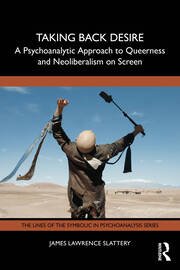
Taking Back Desire: A Psychoanalytic Approach to Queerness and Neoliberalism on Screen
Series Foreword by Ian Parker
Acknowledgements
Introduction
Chapter 1. The Real of Realness: Pose, Paris Is Burning and the limits of authenticity
Chapter 2. The Feminine Shadow: Sexual difference, race and noir in Sharp Objects
Chapter 3. WELCOME 2 REALITY: Ryan Trecartin’s Priority Innfield
Chapter 4. Bodies That Shatter: The negative content of 120 BPM
Conclusion: Coda: Unfixed and Open-Ended
Bibliography and Filmography
Biography
James Lawrence Slattery completed their PhD in English and American Studies from the University of Manchester in 2023, funded by the Arts and Humanities Research Council. They also hold a master's degree in Film Aesthetics with distinction from the University of Oxford, formally organised the Manchester Queer Research Network, and have published essays and reviews in academic journals, edited collections and cultural publications. Their work investigates the moving image and visual culture to rethink identity and subjectivity in late-stage capitalism.
'In an era of rainbow capitalism, James Lawrence Slattery’s Taking Back Desire reasserts the conceptual specificity and radical potential of queer. Crucially, Slattery addresses queerness not at the referential level – where an emphasis on representation might too easily be assimilated to the politics of identity and commodity – but in a variety of audio-visual strategies across diverse media. Taking Back Desire affirms that queerness cannot be precisely located or delimited to a specific practice, but seeks its resonance in alignments between the socially abject and the aesthetically disjunctive that threaten to destabilise the logic of neoliberalism and its future-oriented temporalities. Combining erudite scholarship, meticulous analysis and admirably lucid prose, Taking Back Desire offers engaging and vital readings of contemporary culture – with the discussions of Sharp Objects and 120 BPM offering particular standout moments – to insist upon the renewed and enduring necessity of bringing together screen media, psychoanalysis and queerness to address the contemporary political scene'. Ben Tyrer, Lecturer in Film Theory, Middlesex University, UK, author of Out of the Past: Lacan and Film Noir
'Taking Back Desire represents a monumental step forward in the understanding of the relationship between psychoanalysis and queer theory, especially as evidenced on the screen. James Lawrence Slattery provides a breathtaking series of analyses that show how a psychoanalytic queer theoretical approach can uncover radical insights where we wouldn’t necessarily expect to find them. It’s a book not to be missed for anyone interested in how to think about what we’re watching today'. Todd McGowan, University of Vermont, USA, author of Capitalism and Desire: The Psychic Cost of Free Markets
