





1st Edition
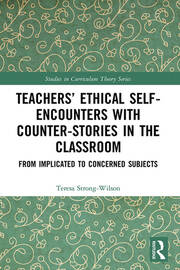
Teachers’ Ethical Self-Encounters with Counter-Stories in the Classroom From Implicated to Concerned Subjects
1. Introduction; 2. Allegory and Juxtaposition; 3. Look-alikes; 4. Memory-work; 5. Mobilizing Memory-work; 6. Ethical Self-encounters; 7. Periscopic Narratives; 8. Recognition and Understanding; 9. From Implicated to Concerned Subjects
Biography
Teresa Strong-Wilson is Associate Professor in the Department of Integrated Studies in Education at McGill University, Canada.
“Strong-Wilson insightfully wrestles with complexities of ethical subjectivity, remembrance, and witnessing in the context of teachers’ autobiographical and classroom encounters with Holocaust and post-colonial counter-stories. She originally interweaves these encounters with dialogic reflections on curriculum theorizing (particularly the work of W.F. Pinar), multidirectional memory work, hermeneutics, and the literature of W.G. Sebald. A compelling and enriching contribution to ‘complicated conversations’ in the fields of curriculum studies and English language arts education!”Claudia Eppert, Associate Professor, Faculty of Education
University of Alberta“Vividly exemplifying the complicated conversation that is the curriculum, Teresa Strong-Wilson reads through one another the varied histories infusing the texts of classroom teachers, fiction and creative non-fiction writers, curriculum theorists, philosophers, and her own reflexive interrogations. Prioritizing study alongside teachers, Strong-Wilson deftly portrays ways that teaching with and to counter-stories might function to both inspire and support ethical self-encounters, wherein one can become conscious of one’s relations with, and responsibility toward, others. Emanating from her elongated and collaboratively enacted research, Strong-Wilson thus theorizes a notion of “concerned subjects,” who, although conscious of themselves as implicated, are able to respond to calls to act, to work toward repair.
By threading aspects of currere, multidimensionality, and auto/biography, Teresa Strong-Wilson offers powerful and timely illustrations of ways that educators might fully examine relations among the subjects that we teach to, the stories we choose to invoke, and ourselves as teachers. In so doing, Strong-Wilson clearly embodies and enlivens curriculum as lived-experience, thus offering a compelling contribution to the field’s complicated conversation.”Janet L. Miller, Teachers College
Columbia University, New York City
