





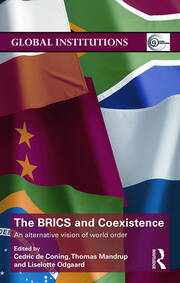
1st Edition
The BRICS and Coexistence An Alternative Vision of World Order
-
Introduction, Cedric de Coning, Thomas Mandrup and Liselotte Odgaard 1. BRICS and coexistence, Cedric de Coning 2. Brazil as a rising power: Coexistence through universalism, Adriana Erthal Abdenur 3. Russia, BRICS and peaceful coexistence: Between idealism and instrumentalism, Flemming Splidsboel Hansen and Alexander Sergunin 4. Indian foreign policy and coexistence: continuity and change in the post-cold war era, Surupa Gupta and Shibashis Chatterjee 5. China and coexistence: Beijing’s policy on energy, United Nations Security Council diplomacy and sovereignty disputes, Liselotte Odgaard and Zha Daojiong 6. South Africa’s ‘diplomacy of ubuntu’: an African approach to coexistence?, Thomas Mandrup and Karen Smith 7. Conclusion: Coexistence in between world order and national interest Cedric de Coning, Thomas Mandrup and Liselotte Odgaard
Biography
Cedric de Coning (South Africa) heads the Peace Operations and Peacebuilding Research Group at the Norwegian Institute of International Affairs (NUPI) and he is also a Senior Advisor on Peacekeeping and Peacebuilding for the African Center for the Constructive Resolution of Disputes (ACCORD). Cedric has a Ph.D. from the Department of Philosophy at the University of Stellenbosch.
Thomas Mandrup is an Assistant Professor at Royal Danish Defence College, Denmark, and an external lecturer at the Centre for African Studies, University of Copenhagen, Denmark
Liselotte Odgaard is an Associate Professor at the Royal Danish Defence College. Her most recent international positions was in 2007 when she was a visiting fellow at the Fairbank Center, Harvard University, and 2008-09, when she was a residential fellow at the Woodrow Wilson International Center for Scholars, Washington, D.C.
‘As the 2014 Fortaleza Summit confirmed, the BRICS’ growing market power translates into geopolitical clout to restructure the global order into a more equitable, rules-based system that respects diversity. This book will be essential to understanding the BRICS as both a normative and a political project’.
Ramesh Thakur, Australian National University, Editor-in-Chief, Global Governance
'I enjoyed reading this well researched book which very succinctly explains the BRICS vision for a new world order as ' coexistence '. The BRICS member states reject hegemony of the world system and will therefore attempt to be an important force for change and reform of the existing global institutions towards more democratic and equitable governance. The recent Agreement at the Sixth BRICS Summit for establishing the New Development Bank ( NDB ) and the Contingent Reserve Arrangement ( CRA ) needs to be viewed through the framework of ' coexistence '. I commend the authors and editors for their incisive work. '
Lt Gen P K Singh, PVSM,AVSM ( Retd ), Director, United Service Institution of India, New Delhi.
