




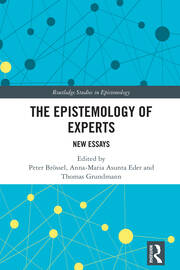
1st Edition
The Epistemology of Experts New Essays
Introduction Peter Brössel, Anna-Maria Assunta Eder, and Thomas Grundmann
Part 1: Analysis of Experts
1. Experts, Epistemic Authorities, and the Problem of Public Exposure Michel Croce
2. Becoming an Expert: Truth, Process, and Authority Jamie Carlin Watson
Part 2: Epistemic Authority
3. Preemptionism and Its Reliabilistic Assumption: A Bayesian Model Christian J. Feldbacher-Escamilla
4. Epistemic Authority and Expertise Arnon Keren
5. What Justifies Believing on the Authority of an Expert? Testimonial Reductionism Versus an Epistemic Second-Personal Reason for Belief Elizabeth Fricker
Part 3: The Social Roles of Experts
6. On Being Entitled to Expect Enlightenment by Expertise Sanford C. Goldberg
7. Intellectual Authority and Education Christoph Jäger
8. Epistemic Anarchy and the Role of Experts Linda Zagzebski
9. Expert Judgment: Overlooked Epistemic Reasons Will Fleisher, Daniel C. Friedman, and Dunja Šešelja
Part 4: Challenges
10. … Elijah Millgram
11. What to Do When Experts Disagree Finnur Dellsén and Øystein Linnebo
12. Inquiry and the Positive Epistemic Value of Diversity Alessandra Tanesini
13. The Infodemic, Epistemic Exclusion in Science Communication, and Distrust in Scientific Expertise Mona Simion and Josephine Adekola
14. Distrusting Expert Testimony and Conspiracy Theories Åsa Wikforss
15. Explaining Alternative Beliefs: Hypocrisy and Trustworthiness in Science Katherine Dormandy
Biography
Peter Brössel is Jr. Professor of Philosophy at Ruhr University Bochum, where he also directs the Emmy Noether Research Group ‘From Perception to Belief and Back Again.’ His research interests include epistemology, philosophy of science, language, and mind, focusing on rational reasoning, confirmation theory, perception, language learning, and social aspects of reasoning.
Anna-Maria Asunta Eder is Research Fellow in the Department of Philosophy at the University of Cologne, specializing in epistemology, philosophy of logic, philosophy of science, and metaphilosophy. Her research addresses topics such as epistemic normativity and rationality, the social dimensions of rational reasoning, and conceptual engineering.
Thomas Grundmann is Professor of Philosophy at the University of Cologne. From 2016 until 2018, he was president of the German Society for Analytic Philosophy. He has published numerously on topics from general epistemology (skepticism, epistemic concepts, a priori knowledge), philosophical methodology, and applied social epistemology, for example, disagreement and epistemic authority.
